

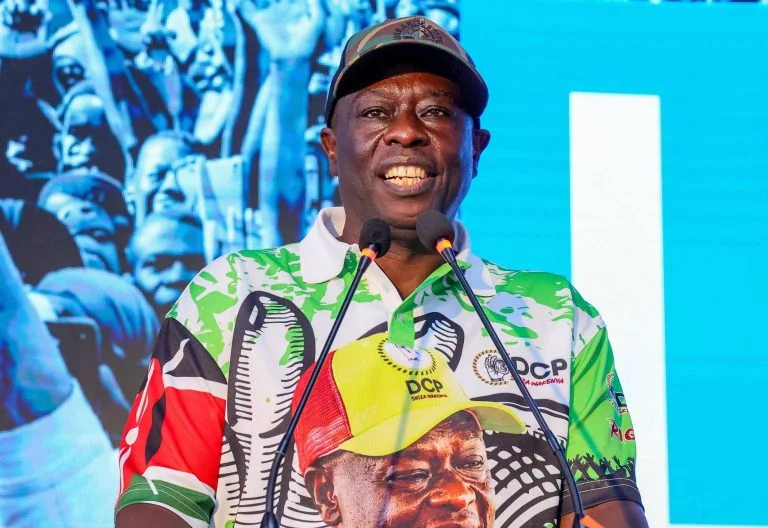
Former Deputy President Rigathi Gachagua is increasingly using the growing number of defections from President William Ruto’s United Democratic Alliance (UDA) to strengthen his Democracy for the Citizens Party (DCP), positioning the outfit as an alternative political vehicle ahead of the 2027 General Election.
What began as a political fallout following his impeachment in October 2024 has gradually developed into a recruitment drive targeting elected leaders, grassroots mobilisers and politicians who previously operated within Ruto’s political establishment.
The latest defections suggest that Gachagua is pursuing a strategy that goes beyond criticising the government. By receiving former UDA allies into DCP, he is seeking to build political structures that could give his party a stronger presence in constituencies across Mt Kenya.
The strategy has also transformed his Wamunyoro residence in Nyeri into a major meeting point for politicians seeking new political affiliations, with the former Deputy President using the gatherings to project DCP as an expanding political organisation.
Turning political defections into party expansion
One of the clearest indications of Gachagua’s recruitment strategy emerged on November 17, when he received three more UDA legislators at Wamunyoro.
The legislators were Gatundu South MP Gabriel Kagombe, Laikipia West MP Wachira Karani and Nyeri Woman Representative Rahab Mukami.
Their entry followed earlier defections involving Runyenjes MP Eric Karemba and other political leaders who have been received into the party.
According to Citizen Digital’s report on the latest MPs joining DCP, Gachagua announced that his party’s parliamentary membership had increased from 19 to 25.
He also claimed that more than 40 MPs had expressed interest in joining DCP, setting December 31, 2026, as the deadline for the current recruitment window.
The recruitment drive gives Gachagua an opportunity to convert political dissatisfaction within UDA into a growing parliamentary and grassroots network.
Newsline previously examined how Wamunyoro is becoming Gachagua’s version of Ruto’s 2022 Karen strategy, with the residence increasingly serving as a centre for consultations, political recruitment and party mobilisation.
Building a political bargaining position
Beyond attracting individual politicians, Gachagua’s recruitment strategy could also strengthen DCP’s position in negotiations with other opposition parties.
In coalition politics, parliamentary numbers, elected leaders and grassroots structures often influence discussions about political partnerships, elective positions and leadership arrangements.
By expanding DCP’s representation before the 2027 election, Gachagua is seeking to establish a party structure that can participate in those negotiations from a stronger organisational position.
His November 13 reception of Runyenjes MP Eric Karemba and 30 Nyeri MCAs illustrated the importance he is attaching to county-level mobilisation.
The Star reported on Gachagua’s growing recruitment drive and his ambitions for DCP, including efforts to popularise the party across Embu County
This approach is significant because political parties require more than nationally recognised leaders to compete effectively. They also need ward-level structures, local organisers and candidates capable of mobilising support within individual constituencies.
Weakening UDA’s influence in its former stronghold
Gachagua’s strategy also places pressure on UDA, particularly in constituencies where elected leaders previously relied on the ruling party’s popularity and association with the presidency.
The 2022 political arrangement brought together Ruto’s national campaign machinery and Gachagua’s Mt Kenya mobilisation networks. Their subsequent fallout disrupted that partnership, leaving the ruling party with the task of rebuilding its regional political structures.
The Star’s analysis of UDA’s declining appeal ahead of the 2027 elections highlighted the growing movement of governors, senators and MPs away from the ruling party.
For Gachagua, receiving politicians previously associated with Ruto allows him to demonstrate that DCP’s recruitment is not limited to his original political supporters.
However, defections by elected leaders should not automatically be interpreted as evidence that their entire voter bases have moved with them.
The challenge of accommodating new entrants
Despite the political opportunities presented by the recruitment drive, Gachagua faces the challenge of balancing newcomers with founding members who supported him during his impeachment.
The arrival of politicians who previously defended Ruto’s administration has reportedly raised concerns among some DCP loyalists, particularly those who feel that their contribution to establishing the party should be recognised.
The tension was highlighted by The Star’s report on the growing differences between DCP defectors and founding loyalists.
The other challenge will be managing nominations. With established politicians joining the party alongside aspiring candidates, competition for parliamentary, gubernatorial and ward positions could generate disagreements.
Newsline previously explored the nomination question that could test Gachagua’s grip on Mt Kenya politics, highlighting the importance of internal democracy and transparent candidate selection.
Can defections translate into political influence in 2027?
Ultimately, Gachagua’s recruitment drive is an attempt to turn the political fallout with Ruto into an opportunity to establish a wider political organisation.
The growing number of elected leaders joining DCP gives the party additional visibility and creates opportunities to expand its presence beyond its original support networks.
However, the real test will be whether these political movements translate into functioning grassroots structures and voter support.
As Newsline’s analysis of how TND is disrupting Mt Kenya politics illustrates, DCP is also operating in a region where other political formations are seeking to attract aspirants and establish independent political influence.
For Gachagua, therefore, the objective is not simply to receive more politicians at Wamunyoro but to build a party capable of managing competing interests and negotiating a meaningful position in the 2027 political contest.
The coming months will reveal whether his recruitment strategy can transform DCP into a broader political organisation or whether the competition for party tickets and leadership positions will create new divisions within his camp.


More Stories
Kindiki Announces Sh55bn Road Upgrade Plan for Kericho
KCB Treasury Division Supports Businesses in Managing Financial Risks
Software Engineering Industrial Attachment in Kenya 2027 at Newsline Media