

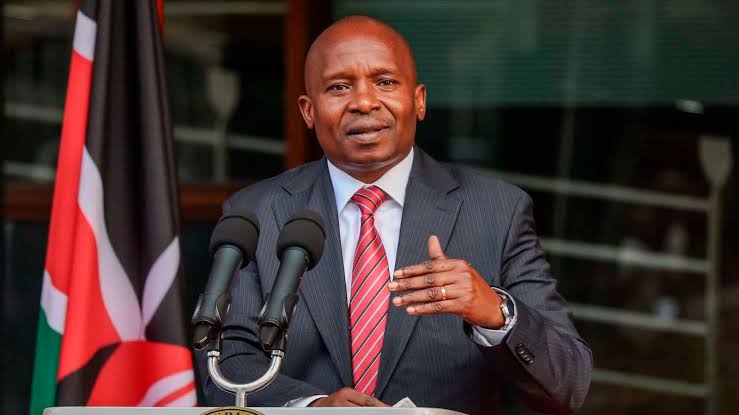
The political slogan “Kumi ya Ruto, Kumi ya Kindiki” is opening a wider debate about the relationship between President William Ruto’s re-election ambitions in 2027 and Deputy President Kithure Kindiki’s possible place in Kenya’s post-Ruto political order.
While the phrase appears to reinforce continuity within the Kenya Kwanza administration, its emphasis on a second decade under Kindiki raises questions about whether some supporters are already looking beyond the next general election to the succession contest of 2032.
At face value, the slogan communicates a simple political message: Ruto should serve another term from 2027 to 2032, followed by Kindiki for the subsequent ten years.
However, political slogans often carry meanings beyond their immediate electoral purpose, particularly when they are repeated by grassroots allies seeking to establish a leader’s identity, influence and place within a governing coalition.
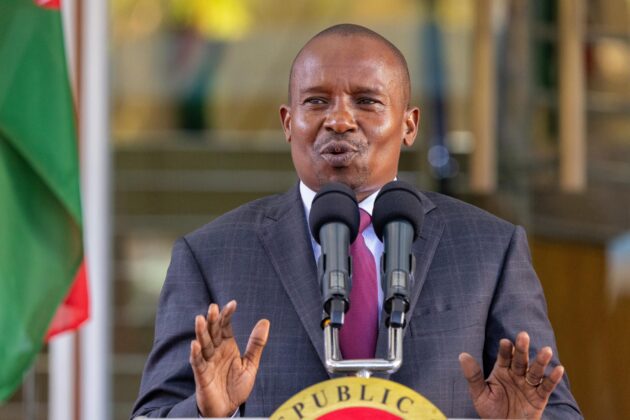
The central question is whether “Kumi ya Ruto, Kumi ya Kindiki” is merely an expression of loyalty to the President and his deputy or an early attempt to normalise Kindiki as a potential successor before the 2027 election has even taken place.
From a running-mate debate to a succession conversation
The emergence of the slogan comes at a time when Kindiki’s political role is expanding beyond his constitutional responsibilities as Deputy President.
His supporters have increasingly presented him as a figure who could preserve the region’s influence within the national government while building a foundation for a future presidential bid.
In September 2026, leaders from Mt Kenya East publicly positioned Kindiki as their preferred presidential candidate for 2032 while pledging to support Ruto’s re-election in 2027.
The position was articulated at a United Democratic Alliance meeting at Kinoru Stadium in Meru, where leaders argued that the region should first consolidate its place within the current administration before pursuing the presidency.
The development suggests that succession discussions are no longer confined to private political conversations.
They are increasingly becoming part of public messaging, with the deputy president’s immediate political future being linked to the longer-term ambitions of leaders seeking a greater role for Mt Kenya in national leadership.
This distinction matters because retaining the deputy presidency in 2027 and securing the presidential nomination in 2032 are two different political contests.
The first depends on the decisions made by Ruto and the ruling coalition ahead of the next election, while the second would require Kindiki to build a broader national coalition capable of competing for the presidency.
The slogan therefore connects two political timelines: the immediate effort to retain power and the longer-term question of who might inherit the ruling coalition’s political machinery.
The Ruto factor: Why 2027 remains central
For Kindiki’s supporters, the argument for supporting Ruto in 2027 is closely connected to their expectations for the region’s political future. Their position is that remaining within the governing coalition could provide Mt Kenya with the influence necessary to negotiate a stronger position in the next phase of national leadership.
Kindiki himself has previously linked support for Ruto’s re-election to the region’s prospects in 2032. In April 2026, he urged Mt Kenya residents to back the President in the next election, describing the future presidential ambition as a goal that would come after the 2027 contest.
That message provides an important context for understanding the slogan. It is not simply about celebrating the relationship between a president and his deputy; it also presents political loyalty today as a possible route to leadership tomorrow.
Yet this approach carries an inherent uncertainty. Political support is rarely a straightforward exchange in which backing an incumbent automatically guarantees the deputy a future presidential ticket. The ruling party’s priorities, the President’s eventual decisions, competing ambitions and the changing interests of coalition partners could all influence the succession process.
The 2027 election must also be won before any post-election succession arrangement becomes politically relevant. Until then, the slogan remains a statement of ambition rather than a binding agreement on who will lead the country after Ruto.
Is Kindiki being positioned as Ruto’s political heir?
The growing emphasis on Kindiki’s future raises a question about the political role of a deputy president who is simultaneously expected to defend the incumbent administration and build his own national profile.
The two responsibilities can reinforce each other. By representing the government at public functions, explaining its development agenda and engaging grassroots leaders, Kindiki can establish relationships that may remain relevant beyond the current administration.
His position also gives him a national platform from which to communicate his political priorities.
However, a future presidential campaign would require more than continuity with the incumbent. Kindiki would have to demonstrate that his appeal extends beyond the support he receives as Ruto’s deputy and that his political identity can accommodate competing regional interests and national policy priorities.
The distinction is particularly important in Mt Kenya, where political leadership is not determined by a single organisation or a unanimous community position.
Different leaders have competing interests, and support for a particular candidate can vary across counties, constituencies and political networks.
The Daily Nation reported in September that leaders from Mt Kenya East were seeking support from Mt Kenya West for Kindiki’s future presidential ambitions, framing the question partly around political reciprocity between the two blocs.
That demand illustrates both the opportunity and the challenge facing the emerging succession campaign. Kindiki’s supporters may see him as a vehicle for regional representation, but presenting him as the automatic choice for 2032 could reopen questions about which leaders and communities have the authority to determine Mt Kenya’s political direction.
An early succession campaign, therefore, would not only be about promoting Kindiki. It would also be about negotiating the terms under which different political constituencies would support him.
The lessons of ‘Yangu Kumi, Ya Ruto Kumi’
Kenya’s political history offers a useful reference point for understanding why succession slogans attract attention long before an election.
The declaration “Yangu kumi, ya Ruto kumi” was associated with the political partnership between former President Uhuru Kenyatta and Ruto when they joined forces ahead of the 2013 General Election.
The arrangement helped communicate continuity between the two leaders and gave their supporters a shared political narrative.
However, the subsequent breakdown of the Kenyatta-Ruto relationship demonstrated that a political understanding made during one electoral period does not necessarily determine the next phase of leadership. Their partnership eventually collapsed, and the two leaders took opposing positions in the 2022 election.
The comparison does not mean that the Ruto-Kindiki relationship will follow the same trajectory. The political circumstances, personalities and alliances are different.
Nevertheless, the historical experience provides a reason to distinguish between a slogan expressing present unity and an agreement that can withstand the pressures of succession politics.
A slogan can help organise supporters around a shared objective, but it cannot by itself settle future questions about party nominations, coalition negotiations or the distribution of political power.
There is also a difference between a political leader endorsing a future ambition and an entire coalition formally committing itself to that ambition. The former can be an important signal; the latter would require clearer evidence of an agreed political arrangement.
Could early succession politics complicate the 2027 campaign?
The timing of the slogan presents a strategic question for the ruling coalition. Can leaders promote Kindiki’s future ambitions without distracting from the immediate objective of defending Ruto’s presidency?
The deputy president has previously cautioned Kenya Kwanza leaders against shifting their attention to the 2032 race before the 2027 election. In July 2026, he urged supporters to concentrate on Ruto’s re-election and the government’s agenda rather than allowing future succession debates to dominate the political conversation.
That position highlights a tension within the slogan itself. Its first half reinforces loyalty to Ruto, while its second half introduces a future leadership contest that could eventually involve other ambitions within the ruling party.
If succession messaging becomes more prominent than the government’s immediate electoral programme, leaders could find themselves navigating competing priorities.
Supporters may begin interpreting present political decisions through the lens of who stands to benefit in 2032, even as the coalition seeks to maintain a common front for 2027.
Conversely, proponents of the slogan may argue that identifying a potential successor early provides a longer-term political horizon for supporters who want assurances that their influence will not disappear after the next election.
Both interpretations are relevant to understanding why the slogan has gained traction. Whether it strengthens unity or introduces new tensions will depend on how political leaders manage the relationship between present commitments and future ambitions.
The Mt Kenya question: Unity, representation and competing interests
The succession debate is also unfolding against the background of efforts to rebuild political support in Mt Kenya following the removal of former Deputy President Rigathi Gachagua from office in 2024.
Kindiki’s supporters have presented him as a figure capable of bringing together different sections of the region while maintaining its connection to the national government. His public engagements have increasingly combined calls for unity, development and support for Ruto’s re-election with efforts to establish his own regional leadership profile.
But regional representation remains a contested political question. Support for Kindiki among some leaders does not establish that the entire region has accepted him as its future presidential candidate.
Nor does endorsement by one group automatically translate into electoral support across Mt Kenya’s diverse constituencies.
The push for a Kindiki presidency in 2032 may therefore serve two purposes. It can provide supporters with a longer-term reason to remain within the ruling coalition, while also opening a debate over how political influence should be shared between Mt Kenya East and Mt Kenya West.
That second dimension could prove particularly significant. If the succession campaign becomes framed primarily as a demand for regional rotation, it may shift the conversation from Kindiki’s individual leadership credentials to a broader question of which community or political bloc should occupy the presidency.
Such a debate would require the competing groups to address more than the identity of a future candidate. It would involve questions about national coalition-building, representation, economic priorities and the extent to which regional interests can be reconciled with a presidential campaign that must appeal to voters across Kenya.
Beyond the slogan: What would make the succession project real?
For “Kumi ya Ruto, Kumi ya Kindiki” to develop into a durable succession project, its supporters would need to move beyond public declarations and establish a political foundation capable of surviving changes in circumstances.
First, Kindiki’s supporters would need to sustain their commitment to the 2027 coalition while clarifying whether their long-term ambitions have the support of the wider ruling party. Public endorsements are evidence of political positioning, but they are not equivalent to a formal nomination or a coalition-wide succession agreement.
Second, Kindiki would need to build a national political identity that is not dependent entirely on his current office or his association with Ruto. A future presidential bid would require engagement with voters and political constituencies beyond his immediate regional base.
Third, the succession conversation would have to accommodate competition. Other leaders may seek the ruling party’s presidential ticket in 2032, and the existence of a slogan today does not remove their constitutional right to pursue political office or the party’s need to manage competing ambitions.
Finally, the political conversation would have to remain connected to public concerns.
Voters may assess the government through the cost of living, employment, public services, infrastructure and the performance of the economy. A succession message that focuses exclusively on the distribution of political positions risks leaving unanswered the question of what future leadership would mean for citizens.
The constitutional framework is also clear on the limits of presidential tenure: Article 142(2) of the Constitution provides that no person may hold the presidency for more than two terms.
Assuming Ruto is re-elected in 2027, the next regular presidential election would be scheduled for 2032, making the succession debate politically understandable even though its eventual outcome remains open.
Conclusion: An ambition taking shape, not a settled succession
The growing use of “Kumi ya Ruto, Kumi ya Kindiki” reflects a political conversation that reaches beyond the 2027 General Election.
By linking Ruto’s proposed second term to Kindiki’s possible presidency, the slogan gives the deputy president’s supporters a framework for presenting current political loyalty and future leadership ambitions as parts of the same project.
Its significance lies in the fact that 2032 is being discussed while the 2027 contest remains unresolved.
That timing makes the slogan both a message of continuity and a signal that sections of the ruling coalition are already thinking about what comes after the incumbent administration.
Whether it develops into a formal succession campaign will depend on decisions that have yet to be made: the composition of the 2027 ticket, the outcome of that election, the ruling party’s future arrangements and Kindiki’s ability to sustain a political coalition beyond his current position.
For now, the slogan is best understood as evidence of an emerging succession ambition rather than proof that the presidency has already been allocated. Its ultimate meaning will depend on whether the political unity it promises can endure the competition that succession inevitably brings.

More Stories
Koimburi Accuses Gachagua of Radicalizing Mt Kenya with ‘One Term’ Campaign
Theranostics: How Lutetium-177 Is Changing the Fight Against Advanced Prostate Cancer
Kenya Cybersecurity Experts Warn of Evolving AI-Powered Threats