

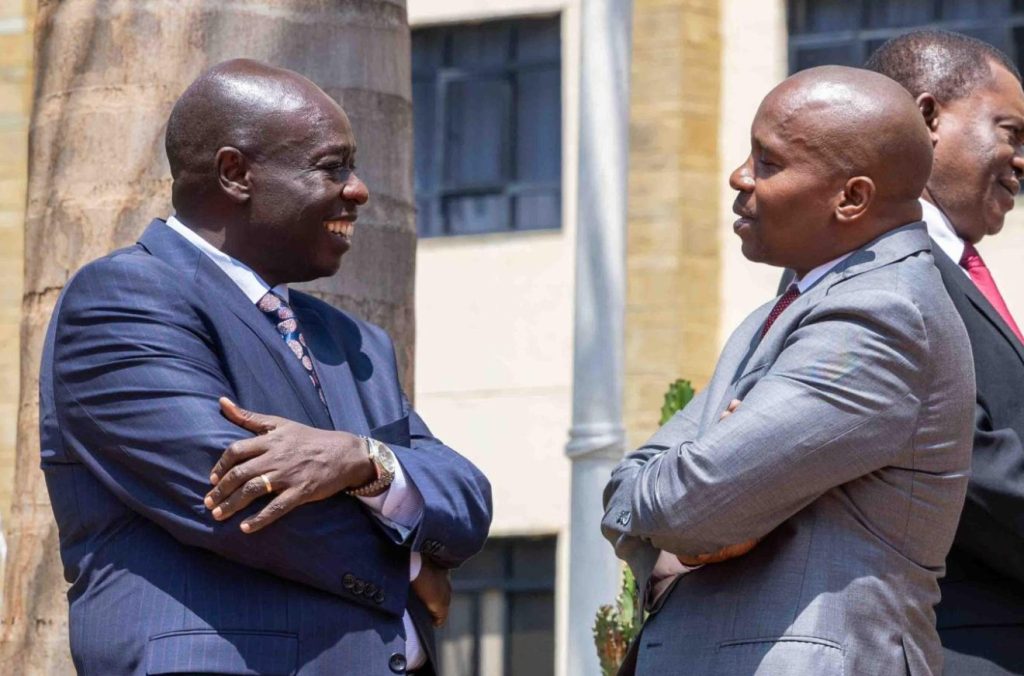
The battle for political control of the Mt Kenya region ahead of the 2027 General Election is increasingly taking shape, with former Deputy President Rigathi Gachagua and his successor, Kithure Kindiki, emerging as central figures in a contest that could determine the political direction of one of Kenya’s most influential voting blocs.
Nearly two years after Gachagua’s impeachment, the political fallout from his fallout with President William Ruto continues to shape the region’s political landscape, creating two competing centres of influence.
Gachagua is seeking to consolidate his support through the Democracy for the Citizens Party (DCP), presenting himself as a defender of Mt Kenya’s political interests and mobilising voters around what he considers the region’s diminished influence in government.
Kindiki, on the other hand, is operating from within government, where his position as Deputy President gives him access to the ruling party’s political machinery and an opportunity to convince voters that remaining within Ruto’s administration offers the region a stronger path to development and national influence.
The contest is therefore bigger than a personal rivalry between two politicians who have occupied the same office. It is increasingly becoming a struggle over who has the political legitimacy to speak for Mt Kenya, negotiate its interests and influence its relationship with the next government.
Gachagua’s DCP strategy and the politics of numbers
Gachagua’s most immediate political objective is to establish DCP as the dominant political vehicle in the Mt Kenya region before the 2027 nominations and General Election.
His recruitment campaign has gathered momentum, with the former Deputy President increasingly using defections from UDA to demonstrate that his political influence remains intact despite his removal from office.
On November 17, Gachagua welcomed Gatundu South MP Gabriel Kagombe, Laikipia West MP Wachira Karani and Nyeri Woman Representative Rahab Mukami into DCP after they abandoned UDA.
He announced that the party’s parliamentary membership had increased from 19 to 25, expressing confidence that the number would rise to 60 by 2027.
“Our transfer window is open to everyone and will close on 31st December 2026. The DCP team has grown from 19 members to 25. I have no doubt that we will have 60 MPs by next year,” Gachagua said.
The defections are politically significant because they suggest that the former Deputy President’s mobilisation efforts are attracting elected leaders who previously operated within Ruto’s political establishment.
The development has also attracted national attention, with Capital FM reporting on the three lawmakers who abandoned UDA for Gachagua’s DCP.
However, the numbers alone do not necessarily establish that Gachagua has secured the loyalty of Mt Kenya voters. Political defections can strengthen a party’s parliamentary presence without automatically translating into grassroots support.
His challenge will be to turn the growing list of political recruits into a united electoral movement capable of surviving competitive party nominations and the pressure of a national presidential contest.
Yet the recruitment drive also exposes one of the biggest political dilemmas facing Gachagua: how to accommodate new entrants without alienating the people who stood with him during his impeachment.
The entry of politicians who previously defended Ruto’s administration has raised questions among some DCP loyalists, particularly those who believe their sacrifices during the former Deputy President’s political battles should count when the party distributes positions and nominations.
Read Also: The Nomination Question That Could Test Gachagua’s Grip on Mt Kenya Politics.
The concerns present Gachagua with a delicate balancing act. While attracting elected leaders could strengthen DCP’s national outlook, failing to manage the expectations of founding members could create internal divisions before the party even enters the 2027 campaign season.
His other challenge is that Mt Kenya politics is no longer a straightforward contest between DCP and UDA. Kiharu MP Ndindi Nyoro, former Interior Cabinet Secretary Justin Muturi, former Agriculture Cabinet Secretary Peter Munya, former presidential candidate Martha Karua and Jubilee’s Fred Matiang’i are among the figures shaping alternative political conversations in the region.
Their presence means Gachagua must compete not only with Kindiki and Ruto’s political machinery but also with leaders who have their own grassroots networks and ambitions.
A November 7 report by The Star highlighted how rival political parties associated with Nyoro, Matiang’i, Karua, Munya and Muturi are challenging Gachagua’s efforts to establish himself as Mt Kenya’s dominant political figure.
The report, Battle for the Mountain: Gachagua’s Grip Threatened by Rising Rivals, illustrates why the former Deputy President’s political project faces competition beyond the ruling party.
Kindiki’s government machinery and the development card
Unlike Gachagua, whose political comeback is largely anchored on opposition mobilisation, Kindiki’s approach is built around defending the government’s record while strengthening UDA’s grassroots structures.
Since assuming the Deputy President’s office in November 2024, Kindiki has increasingly positioned himself as the principal government link to Mt Kenya, using development tours, meetings with community elders and engagements with elected leaders to rebuild the administration’s support.
His strategy is to convince voters that their political interests are better served through continued engagement with the national government than through confrontation with State House.
Road construction, agricultural reforms, markets, affordable housing, electricity connectivity and efforts to address illicit alcohol have featured prominently in his regional engagements.
The Deputy President has also been working to strengthen UDA’s grassroots structures by meeting polling centre officials, local politicians and community leaders across the region.
His strategy reflects an understanding that political influence cannot be maintained through national leadership positions alone. It requires networks extending to polling stations, villages, community organisations and local political formations.
Read Also: How Kindiki Is Mirroring Ruto’s 2022 Playbook to Rebuild UDA’s Mt Kenya Support.
Kindiki’s strongest political advantage is his proximity to the President and his ability to present government projects as evidence of continued engagement with the region.
However, this advantage also comes with considerable responsibility. As the most senior government representative from Mt Kenya, he is likely to bear much of the political responsibility for the administration’s successes and failures in the region.
If voters believe that development promises are not translating into tangible improvements in their lives, his position within government could become a political liability rather than an advantage.
His political future is also closely tied to his relationship with Ruto, raising questions about how far he can independently negotiate the region’s interests while remaining loyal to the President.
The debate over Kindiki’s political ambitions has also gained momentum, particularly with supporters increasingly discussing his prospects beyond the current administration.
Read Also: Kindiki’s Political Future: Why He Is Betting on Ruto.
The battle over who speaks for Mt Kenya
Perhaps the most defining aspect of the rivalry is the struggle over regional political leadership and the institutions through which Mt Kenya’s interests should be represented.
Gachagua has built his political argument around the idea that the region needs a strong bargaining position and should not surrender its political influence without clear commitments from presidential candidates.
Kindiki, meanwhile, has sought to present himself as a unifying figure capable of representing the region from within government.
This difference became particularly visible on September 19, when more than 10,000 GEMA elders endorsed Kindiki at Kirigiti Stadium in Kiambu County, positioning him as a spokesperson for the wider region.
The endorsement was an important political statement, given that Gachagua had already presented himself as the leading voice of Mt Kenya.
However, it also attracted questions about whether a gathering of elders could confer authority to speak for an entire region without wider consultation.
The question is whether cultural endorsements and political meetings can translate into actual electoral support.
A report by Nation titled Kindiki Coronation Exposes Deeper Power Fight examined the political significance of the Kirigiti ceremony and the competing claims over who should represent Mt Kenya.
For Gachagua’s allies, endorsement by elders does not necessarily translate into grassroots political support. For Kindiki, however, the backing gives him a platform from which to build a parallel political network across the region.
The development has opened another political front in the rivalry, with both leaders seeking to establish the legitimacy of their respective approaches.
Read Also: Inside Kindiki’s Latest Move to Challenge Gachagua’s Wantam Politics in Mt Kenya.
The contest is therefore about more than who commands larger political gatherings. It is increasingly about who can establish lasting relationships with communities and convince voters that their political interests are being represented.
Ruto’s dilemma and the 2027 succession calculations
The rivalry between Gachagua and Kindiki also presents President William Ruto with a difficult political equation as he prepares to defend his presidency.
Mt Kenya was instrumental in Ruto’s 2022 electoral victory, and retaining a substantial share of its support will be important to his re-election strategy.
However, the political fallout following Gachagua’s impeachment has complicated the relationship between the President and a section of the region’s electorate.
Ruto has continued to defend his administration’s development agenda while challenging political leaders who seek to mobilise entire communities behind individual personalities.
On November 18, during his State of the Nation Address, the President took an apparent swipe at Gachagua’s regional mobilisation, warning against reducing communities to voting blocs.
“No community should be reduced to a voting bloc. No region should be asked to surrender its judgement to a personality,” Ruto said.
Although he did not mention Gachagua directly, the remarks came amid the former Deputy President’s efforts to consolidate Mt Kenya behind DCP.
Capital FM reported on Ruto’s remarks challenging voting bloc politics, highlighting the growing disagreement over whether communities should negotiate politically as blocs or allow voters to make independent choices.
The remarks underline the President’s determination to challenge the politics of regional political ownership.
For Kindiki, the challenge is to defend Ruto’s political interests without appearing to subordinate Mt Kenya’s regional demands to the national government’s agenda.
He must demonstrate that his position in government gives the region meaningful influence in decision-making, resource allocation and the distribution of development opportunities.
For Gachagua, the opportunity lies in presenting himself as an alternative political negotiator capable of securing better terms for the region in the next administration.
However, the former Deputy President must also convince voters that his political movement has a national agenda beyond opposing Ruto and reclaiming the influence he lost following his impeachment.
The voters, not political rallies, will decide
Despite the growing political activity surrounding the two leaders, the ultimate battle will not be settled by the number of politicians attending their meetings, the size of stadium crowds or the number of MPs changing political parties.
It will be decided by voters whose priorities extend beyond political rivalries.
Farmers want better returns for their coffee, tea and dairy produce. Young people are looking for employment opportunities, while traders want better business conditions and improved infrastructure. Other residents are concerned about the cost of living, access to healthcare, education and the government’s ability to deliver on its promises.
These concerns could ultimately determine whether voters remain aligned with the ruling administration or embrace the opposition’s political alternative.
Gachagua’s strength lies in his ability to mobilise dissatisfaction and turn it into political loyalty. However, he must demonstrate that DCP can accommodate competing interests, conduct credible nominations and develop a national political programme capable of attracting support beyond Mt Kenya.
Kindiki’s strength lies in his government position, access to State House and ability to associate himself with development projects. But he must prove that these advantages can translate into genuine grassroots confidence rather than temporary political support driven by government access.
The emergence of other political figures, particularly Ndindi Nyoro, also suggests that the region’s political future may not be determined by a two-man contest alone. Alternative political formations could complicate both camps’ efforts to consolidate support.
Ultimately, the battle between Gachagua and Kindiki is a contest between two different routes to political influence: one built around grassroots mobilisation and opposition politics, the other around government access, development and institutional networks.
Both leaders have something to prove.
Gachagua wants to demonstrate that his impeachment did not end his political career or weaken his influence over the region. Kindiki wants to establish that he can command political loyalty beyond his position as Deputy President and become a credible regional leader in his own right.
But perhaps the biggest question facing both camps is whether Mt Kenya voters are prepared to follow political personalities into another election or whether they will demand a new form of political bargaining based on measurable development, economic interests and accountability.
The 2027 contest could therefore produce a different political outcome from what either camp currently anticipates. Gachagua may command considerable grassroots enthusiasm without securing a united political coalition, while Kindiki may enjoy government backing without fully restoring Ruto’s relationship with the region.
For now, the Mountain remains politically contested, and neither Gachagua nor Kindiki can confidently claim ownership of its electoral future.
The real winner will be the leader who convinces voters that their political loyalty can deliver more than campaign promises, regional rhetoric and positions in government.

More Stories
Why Gachagua’s DCP Is Attracting Disgruntled Mt Kenya Politicians Ahead of 2027
Why Political Defections Are Changing the 2027 Succession Debate in Mt Kenya
Muturi, Maraga Lead Opposition Push for Four Major Electoral Reforms Ahead of 2027 Polls