

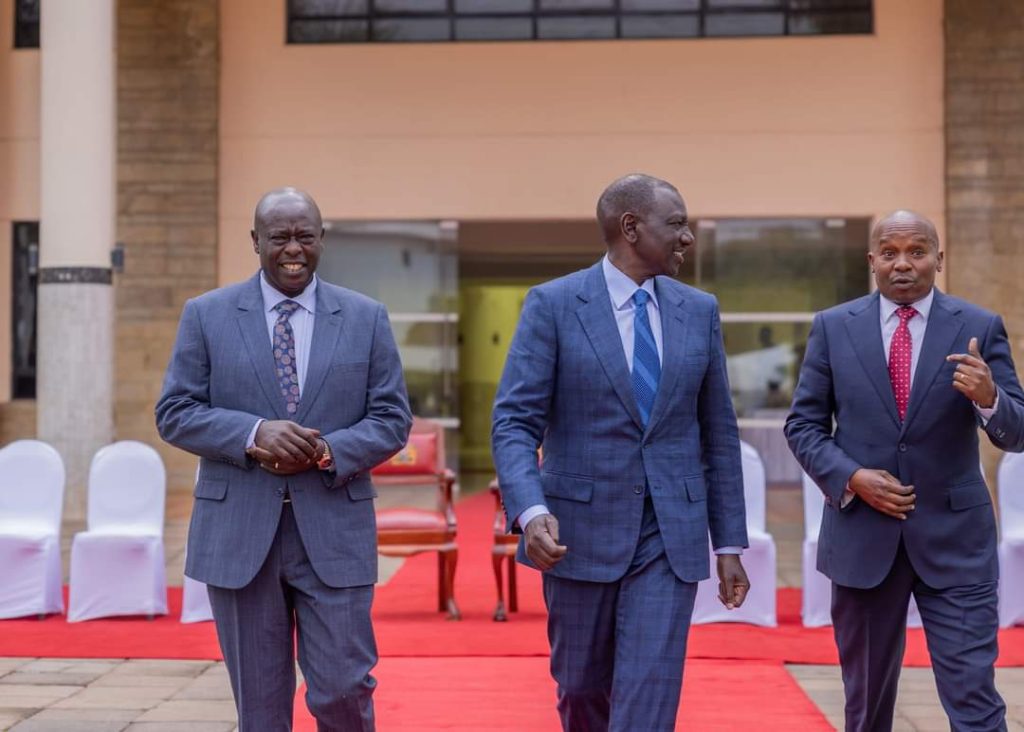
The growing wave of political defections in the Mt Kenya region is reshaping political calculations ahead of the 2027 General Election, exposing cracks within President William Ruto’s political network while strengthening former Deputy President Rigathi Gachagua’s efforts to establish himself as the region’s dominant political voice.
What initially appeared to be isolated disagreements between individual politicians and the ruling United Democratic Alliance (UDA) has gradually developed into a broader political realignment, with governors, senators and Members of Parliament reconsidering their political affiliations.
At the centre of the emerging political contest is the Democracy for the Citizens Party (DCP), which has become an increasingly attractive political destination for leaders distancing themselves from Ruto’s administration.
The defections are not merely changing party membership. They are influencing conversations about political leadership, regional representation, the 2027 presidential contest and the succession arrangements that could emerge after the next election.
For Ruto, whose 2022 presidential victory was significantly supported by Mt Kenya voters, the changing political environment presents a difficult challenge. For Gachagua, it offers an opportunity to rebuild his political influence and demonstrate that his support extends beyond the loyalists who stood with him during his impeachment.
The impeachment fallout and collapse of the 2022 political alliance
To understand the current defections, it is important to revisit the political events that changed the relationship between Ruto and the Mt Kenya electorate.
In 2022, Gachagua played a central role in mobilising the region behind Ruto’s presidential bid. Their partnership helped UDA establish a strong political foothold in Central Kenya, with the former Mathira MP emerging as an influential political mobiliser.
However, their relationship deteriorated, culminating in Gachagua’s impeachment in October 2024. His removal created a political opening that has since developed into a major contest over who speaks for Mt Kenya.
Ruto subsequently elevated Kithure Kindiki to the Deputy President’s position, hoping to maintain the region’s political support through a familiar leadership structure.
However, replacing Gachagua in government did not automatically translate into retaining his political influence among voters. The contest has since evolved into what Newsline previously examined in its analysis of Gachagua and Kindiki’s battle for Mount Kenya’s political soul ahead of 2027.
Gachagua turned his departure from government into a political mobilisation campaign, presenting himself as a defender of the region’s interests and building DCP as an alternative political vehicle.
DCP becomes a destination for former Ruto allies
The growing number of politicians abandoning UDA for DCP illustrates how rapidly political calculations are changing.
Among the notable figures associated with Gachagua’s political camp are Murang’a Governor Irungu Kang’ata, Nyandarua Governor Kiarie Badilisha, Nakuru Senator Tabitha Karanja and several legislators from the region.
The movement has attracted considerable attention, with The Star’s report on defections rocking UDA, ODM and Jubilee ahead of 2027 highlighting how emerging political formations are benefiting from the changing loyalties.
On November 17, Gachagua received three more legislators at his Wamunyoro residence in Nyeri: Nyeri Woman Representative Rahab Mukami, Gatundu South MP Gabriel Kagombe and Laikipia West MP Wachira Karani.
The latest arrivals were also reported by Daily Nation in its coverage of Gachagua’s growing political influence in UDA and Jubilee.
The defections demonstrate that DCP is increasingly positioning itself as a political home for leaders seeking to distance themselves from UDA ahead of the next election.
However, the recruitment drive also exposes a difficult question for Gachagua: whether the pursuit of political numbers could undermine the loyalty of those who stood with him when his political fortunes were at their lowest.
Some founding supporters have reportedly expressed reservations about welcoming politicians who previously attacked Gachagua and his allies.
This presents a delicate balancing act for the former Deputy President. While attracting elected leaders strengthens DCP’s national visibility, he must also reassure his original supporters that their contribution and loyalty will not be overlooked.
The tensions have become a significant political concern, as explored in The Star’s analysis of defectors versus loyalists in Gachagua’s DCP.
Ruto and Kindiki face a difficult Mt Kenya political equation
The defections have increased pressure on Ruto and his deputy, Kindiki, to reconsider their political approach to the region.
Kindiki has been at the forefront of efforts to rebuild the government’s relationship with Mt Kenya through development messaging, public engagements and attempts to consolidate support among elected leaders.
His strategy has increasingly focused on grassroots mobilisation and development as he seeks to counter Gachagua’s influence. In an earlier analysis, Newsline examined how Kindiki is mirroring Ruto’s 2022 playbook to rebuild UDA’s Mt Kenya support.
However, the growing influence of DCP means the Deputy President faces a difficult political assignment: convincing voters that the region can retain meaningful influence within the Kenya Kwanza administration without necessarily returning to Gachagua’s political camp.
President Ruto has also entered the debate, recently cautioning political leaders against treating entire communities as voting blocs. His remarks were widely interpreted against the backdrop of Gachagua’s mobilisation in Mt Kenya, as reported by Capital FM in its coverage of Ruto’s remarks on Mt Kenya voting bloc politics.
For Kindiki, the stakes extend beyond defending the government’s record. His own political future and potential national ambitions could be influenced by how effectively he manages the relationship between the presidency and the Mt Kenya electorate.
The succession debate is becoming bigger than party defections
Beyond the immediate contest between UDA and DCP, the political movements are raising a more consequential question about Mt Kenya’s place in the next government.
The region has historically sought influential positions in national leadership, particularly within presidential coalitions. Its substantial voting population gives it considerable bargaining power during election campaigns and post-election negotiations.
However, the emerging political divisions have created uncertainty over who will negotiate on behalf of the region in 2027.
Gachagua wants to consolidate his position as the region’s principal political voice, while Kindiki remains an influential figure within the government.
The debate is further complicated by conversations about Kindiki’s political ambitions beyond the next election, an issue explored in Newsline’s analysis, Is Kumi ya Ruto, Kumi ya Kindiki an early succession campaign for 2032?.
Other political personalities are also positioning themselves to challenge the dominance of the two leaders, making the succession question increasingly complicated.
2027 will determine who controls Mt Kenya’s political direction
Ultimately, the political defections unfolding in Mt Kenya are part of a wider struggle over regional leadership, presidential succession and the future of Kenya’s political coalitions.
For Gachagua, the immediate objective is to transform the growing number of defectors into a disciplined political movement capable of influencing the presidential contest.
For Ruto and Kindiki, the priority is to prevent the erosion of a political base that delivered significant electoral support in 2022.
The most important question is whether Mt Kenya will approach the 2027 election as a united political bloc or as competing factions pursuing different presidential interests.
One thing is becoming increasingly clear: political defections are no longer just about finding new party tickets. They are changing the balance of power, redefining political loyalties and shaping the negotiations that will determine Mt Kenya’s place in Kenya’s next government.

More Stories
Why Gachagua’s DCP Is Attracting Disgruntled Mt Kenya Politicians Ahead of 2027
How Gachagua Is Turning UDA Defections Into a 2027 Political Opportunity
Muturi, Maraga Lead Opposition Push for Four Major Electoral Reforms Ahead of 2027 Polls