


For Dr Joyce Murabu, the founder of Joy Sunrise Medical and Technical College in Thika, caregiver training is not simply another course on the college curriculum but part of a wider effort to prepare young Kenyans for an evolving healthcare sector and a labour market that increasingly extends beyond the country’s borders.
During an interview, Murabu spoke passionately about the need to change the way Kenyans perceive caregiving, arguing that the profession requires specialised skills, patience, compassion and a strong sense of responsibility, particularly because caregivers often work with elderly people, children, people living with disabilities and patients who require continued support outside traditional healthcare facilities.
“Caregiving is a very important course because there is a growing demand for people who can take care of the elderly, children and people living with different conditions,” Murabu said, explaining why she has continued to invest in promoting the course at Joy Sunrise Medical and Technical College.
For her, the objective is not simply to enrol students, take them through classes and issue certificates at the end of their training, but to give them practical competencies that can enable them to find employment, become self-reliant and, where they meet the required standards, compete for opportunities in international labour markets.
“We are not just interested in giving people certificates; we want to give them skills that they can use to earn a living,” she said.
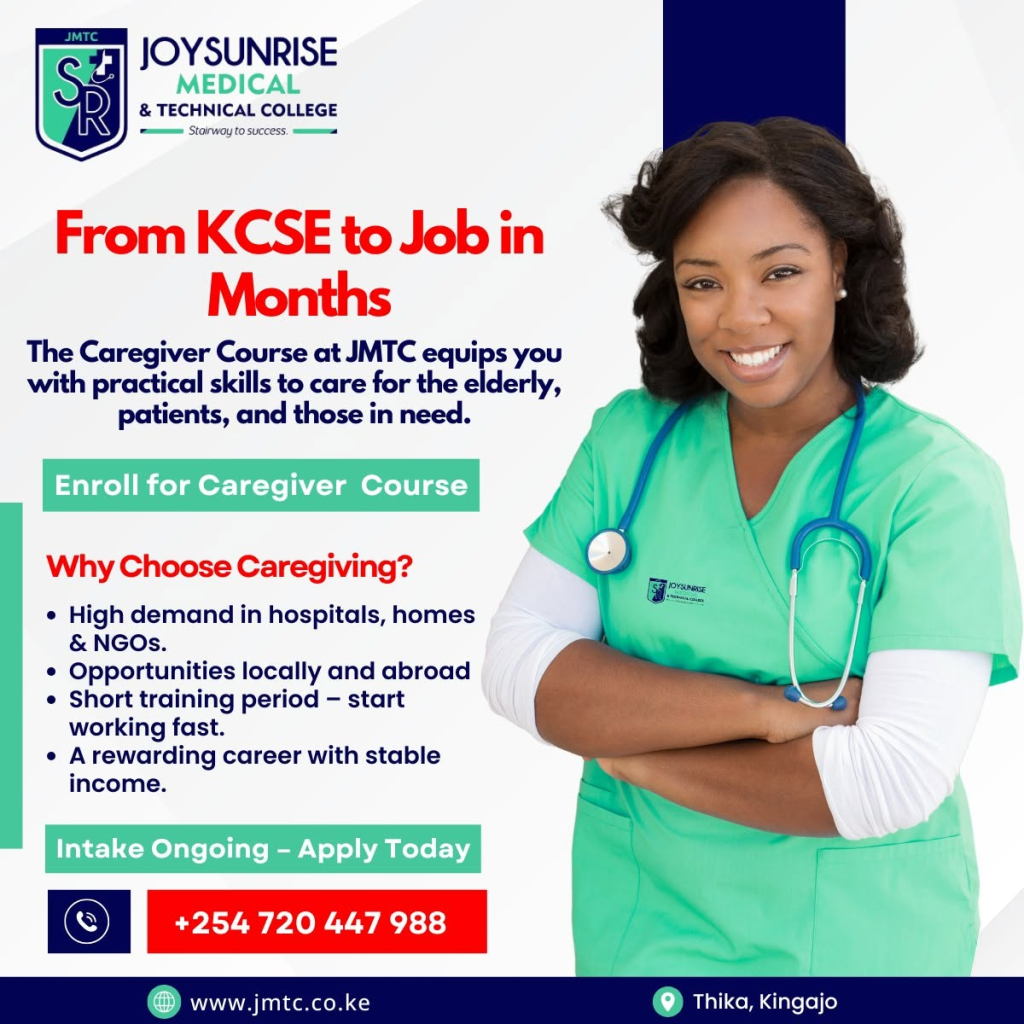
A profession gaining importance
Murabu’s growing emphasis on caregiver training comes at a time when Kenya’s healthcare system is placing increasing attention on services delivered closer to where people live, with the government’s Universal Health Coverage agenda putting greater emphasis on preventive and primary healthcare rather than relying exclusively on hospitals to respond when people become seriously ill.
The government’s Community Health Promoter programme is part of this transformation, with the Ministry of Health reporting that more than 107,000 Community Health Promoters have been deployed across the country’s 47 counties to provide preventive and promotive health services at household level, while efforts have continued to strengthen their training, equipment, digital systems and welfare.
Although caregivers and Community Health Promoters perform different roles, Murabu believes the expansion of community-level healthcare demonstrates why there is an increasing need for people with practical knowledge of patient support, home-based care, elderly care and other services that complement the work performed by doctors, nurses and other health professionals.
“The way we look at healthcare is changing, and we need people who can support patients and families not only when they are in hospital but also when they go back home,” she said.
The distinction is important because caregiver training should not be confused with professional nursing or with the role of Community Health Promoters, whose work includes health education, disease prevention, household registration, referrals and linking communities with formal health facilities.
Instead, caregivers occupy a different part of the healthcare and social-care chain, supporting individuals with daily activities and providing companionship and practical assistance while working within the limits of their training and referring medical concerns to qualified health professionals.
Preparing young people for the global market
For Murabu, however, the importance of caregiver training goes beyond the changing needs of Kenyan families because she is also looking at the growing international demand for people who can provide professional care, particularly as populations age and countries search for workers to support elderly and vulnerable people.
Kenya has increasingly embraced labour migration as part of its employment strategy, with the government seeking to connect trained Kenyan workers with legitimate opportunities abroad while simultaneously strengthening regulation around recruitment, pre-departure preparation and protection against exploitation.
The Ministry of Labour has been working on reforms aimed at improving the recruitment and deployment of Kenyans seeking jobs abroad, while also warning jobseekers about rogue recruitment agencies and individuals who exploit the desperation of young people looking for employment opportunities outside the country.
Murabu sees the international market as an opportunity, but she insists that Kenyan youth must first acquire the skills and professional discipline required by employers.
“There is a demand for caregivers outside the country, and that is something our young people need to know, but you cannot just wake up and say that you want to go abroad because you must have the skills, the right attitude and an understanding of what the employer expects from you,” she said.
Her message is therefore different from the often simplistic narrative that presents overseas employment as an easy escape from Kenya’s unemployment crisis, because she believes that international opportunities should be pursued through proper training, legitimate recruitment channels and a clear understanding of the responsibilities that come with working in another country.
“You cannot just say, ‘I want to go abroad’; you must know how to handle a patient, how to communicate, how to provide personal care and how to conduct yourself professionally,” she said.
Changing how Kenyans view caregiving
One of Murabu’s biggest challenges, however, is not simply convincing young people to enrol but changing the perception that caregiving is an occupation that should be considered only by people who have failed to secure opportunities in more traditionally respected professions.
She argues that professional caregiving requires a combination of technical knowledge and human qualities, because the people receiving care may be elderly, sick, disabled, emotionally vulnerable or unable to perform some basic daily activities without assistance.
“People sometimes look at caregiving and think it is just about helping somebody in the house, but it is much more than that because you are dealing with someone’s life, their dignity and their wellbeing,” she said.
Murabu believes that this understanding should begin during training, which is why she advocates for programmes that expose students to the practical realities of caring for another person instead of concentrating solely on classroom theory.
“You need patience, you need to understand the person you are taking care of and you need to know how to communicate because sometimes the person may not even be able to tell you exactly what they are feeling,” she explained.
It is this combination of technical ability and personal responsibility that she believes can make Kenyan caregivers competitive in both domestic and international markets.
Beyond certificates
At Joy Sunrise Medical and Technical College, Murabu says her larger ambition is to ensure that students leave with something more valuable than a certificate that simply confirms they attended a course.
She wants graduates to have the confidence to walk into a workplace knowing what is expected of them, while also having the practical ability to provide care professionally and understand when a situation requires the intervention of a qualified healthcare professional.
“I don’t want somebody to come to college, get a certificate and then go home and start asking what next; we have to train people for the opportunities that are available,” she said.
That philosophy reflects a broader debate about Kenya’s education system, where increasing numbers of young people graduate every year while employers continue to complain about skills gaps and the mismatch between qualifications and workplace requirements.
Murabu believes technical and vocational institutions have an important role in closing that gap by identifying sectors where there is actual demand and then preparing learners with the practical skills required to enter those sectors.
“We have to ask ourselves what employers are looking for, what skills are needed and how we can prepare our young people for those opportunities,” she said.
The overseas dream comes with risks
While Murabu is optimistic about international opportunities for trained caregivers, she is equally conscious of the risks facing young Kenyans who are desperate to find jobs abroad, particularly those who fall victim to recruitment agents promising guaranteed employment in exchange for large sums of money.
She says students should understand that legitimate overseas employment requires proper documentation, verified recruitment channels, appropriate qualifications and a clear employment contract rather than promises made through social media or informal networks.
“People should be very careful because if someone tells you that you can go abroad without proper training or through shortcuts, you should ask yourself whether that opportunity is genuine,” she said.
Her warning echoes concerns raised by the government as it attempts to strengthen Kenya’s labour-migration framework and protect workers from exploitation, particularly in situations where recruiters charge excessive fees or send workers abroad without adequate information about their contracts and working conditions.
For Murabu, therefore, promoting caregiver training and promoting overseas opportunities must go hand in hand with educating young people about responsible migration.
Where caregiving fits into Kenya’s healthcare transformation
The wider transformation of Kenya’s healthcare system gives the caregiver conversation an additional layer of relevance, particularly as the government continues to strengthen primary healthcare and community-based services through the Community Health Promoter programme.
The Ministry of Health has described CHPs as a critical link between households and formal health facilities, with their responsibilities including health promotion, disease prevention, early identification of health problems and referrals, while the government has continued to invest in training and supporting the community health workforce.
Caregivers are not replacements for CHPs, nurses or doctors, but Murabu argues that they can complement the wider healthcare system by helping families manage everyday care needs and supporting people who require assistance after leaving hospital.
“Healthcare is not only about doctors and nurses because there are many people who contribute to the wellbeing of a patient, and caregivers are part of that picture,” she said.
That broader understanding of healthcare is central to her argument that caregiving should be treated as a professional skill rather than an informal responsibility that anyone can perform without training.
A personal mission
For Murabu, the work at Joy Sunrise Medical and Technical College is ultimately about giving young people an opportunity to build independent lives through skills that have a practical value in the marketplace.
She says one of the most rewarding parts of running the institution is watching students arrive unsure about their future and eventually leave with the confidence that comes from knowing they possess a skill that can be used to earn an income.
“When I see a young person come here without knowing what they want to do and later leave with a skill, that gives me satisfaction because I know that person now has something they can use to change their life,” she said.
Her vision is therefore not limited to producing caregivers for the Kenyan market but to helping create a generation of trained professionals who can serve families at home while also taking advantage of legitimate opportunities in countries where demand for care workers continues to grow.
“I want our students to leave here knowing that they have something they can use, and I want them to be able to support themselves and their families,” she said.
As Kenya continues to grapple with youth unemployment while simultaneously positioning its skilled workforce for opportunities in the global labour market, Murabu believes institutions such as Joy Sunrise Medical and Technical College have a role to play in preparing young people for that changing reality.
Her caregiver programme sits at the intersection of those two conversations — Kenya’s changing healthcare needs and the global demand for trained care workers — and for Murabu, the opportunity lies in ensuring that Kenyan youth are not simply looking for jobs but are equipped with skills that give them a realistic chance of competing for them.
“Education should change someone’s life,” Murabu said, reflecting on the philosophy behind her institution, “and that is what we are trying to do.”



More Stories
How Kindiki is mirroring Ruto’s 2022 playbook to rebuild UDA’s Mt Kenya support
Ruto Says Sh2.2 Trillion Dangote Refinery Will Transform Kenya’s Industrial Economy
Optiven Highlights Growing Demand for Plots in Kitengela in 2026