

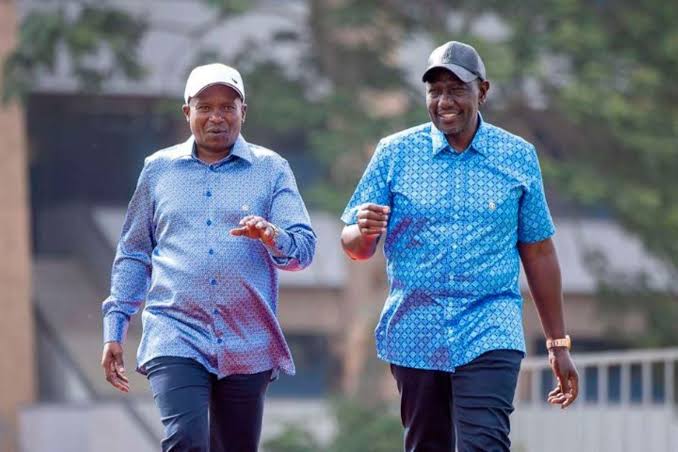
Kindiki’s Political Future: Why He Is Betting on Ruto
Deputy President Kithure Kindiki’s political future is becoming increasingly intertwined with President William Ruto’s re-election ambitions, as the former senator positions himself as one of the administration’s most consistent defenders ahead of the 2027 General Election.
Since assuming office in November 2024 following the impeachment of Rigathi Gachagua, Kindiki has maintained a firm position in support of Ruto, repeatedly dismissing speculation about divisions within the country’s top leadership and insisting that the Kenya Kwanza partnership remains intact.
His approach raises an important political question: Is Kindiki simply fulfilling his responsibilities as Deputy President, or is he making a calculated investment in a political partnership that could shape his own presidential ambitions beyond 2027?
The question is particularly significant given the political contest unfolding in Mt Kenya, where Kindiki is seeking to consolidate support for Ruto while facing competition from Gachagua, who has established an alternative political platform through the Democracy for the Citizens Party (DCP).
For Kindiki, the stakes go beyond defending the current administration. His political standing, influence within government and possible ambitions for the country’s top seat in the future could all be influenced by how the Ruto partnership unfolds.
The 2027 bargain: Why Kindiki wants Ruto to serve a second term
Kindiki has offered one of the clearest explanations of his political calculations, arguing that Mt Kenya’s support for Ruto in 2027 could put the region in a stronger position to pursue the presidency in 2032.
During a meeting with grassroots leaders and professionals from Maara Constituency in Tharaka Nithi County on April 6, 2026, the Deputy President urged residents to reject calls for Ruto to serve only one term.
He argued that supporting another presidential candidate in 2027 could leave the region waiting longer before getting an opportunity to produce a president.
“We have no option next year but to reelect President Ruto. A cow that is heavy with a calf cannot be slaughtered. After the re-election of President Ruto next year, we will only wait for five years. Then in 2032, the calf will be born,” Kindiki declared.
Citizen Digital
The statement offered an important insight into how Kindiki views the relationship between the 2027 election and the region’s long-term political ambitions.
Rather than presenting Ruto’s re-election as an isolated political objective, he has linked it to the possibility of Mt Kenya producing the country’s next president in 2032.
His argument is that supporting Ruto for another term would preserve the current political arrangement and potentially create an opportunity for the region to negotiate for the presidency when Ruto completes his constitutional tenure.
This is a political calculation that could explain why Kindiki has remained firmly aligned with the President despite the emergence of competing political voices in Mt Kenya.
It also suggests that his support for Ruto is not necessarily a surrender of his own ambitions but could be part of a broader strategy to secure a political pathway for himself and the region.
The emerging ‘Kumi ya Kindiki’ movement
The conversation around Kindiki’s political future has increasingly moved beyond his position as Deputy President to the possibility of succeeding Ruto.
A section of Mt Kenya leaders has started popularising the slogan ‘Kumi ya Kindiki’, which advocates for a decade of Kindiki’s leadership after Ruto’s expected departure from office in 2032, should he win re-election.
The growing conversation suggests that some of his political allies are already thinking about the post-Ruto political arrangement even as they campaign for the President’s second term.
In October 2026, Kindiki’s political engagements in Kiambu provided a glimpse into how the succession conversation is gaining momentum.
During a public event on October 13, the Deputy President appeared to acknowledge the growing calls for his own political future, joking about whether his supporters were considering four terms for him after discussing two terms for Ruto and local elected leaders.
“I have heard you talking about Ruto’s two terms, Kiambu MP Machua Waithaka two terms, Njuguna Ka Wanjiku two terms, what about me? I have not heard you talking about me, are you saying four terms? Are you sure? Four terms?” he asked, prompting chants from the crowd.
The Star
The remarks were significant because they came while Kindiki was still campaigning for Ruto’s re-election, illustrating how the 2027 and 2032 political conversations are increasingly being linked by his supporters.
Senate Majority Leader Aaron Cheruiyot has also expressed confidence in Kindiki’s prospects of succeeding Ruto, arguing that the Deputy President should remain in the running-mate position in 2027.
The Standard
However, the ‘Kumi ya Kindiki’ campaign remains an expression of political ambition among his supporters rather than an established succession agreement within Kenya Kwanza.
The President has not publicly guaranteed Kindiki the opportunity to succeed him.
Why Mt Kenya is central to Kindiki’s political ambitions
Kindiki’s political calculations are closely tied to the future of Mt Kenya, one of the country’s most influential voting blocs.
The region played a major role in Ruto’s 2022 presidential victory, but the political fallout following Gachagua’s impeachment has complicated the administration’s efforts to maintain that support.
Gachagua has since built an alternative political platform through DCP, challenging the government’s leadership and seeking to consolidate support among Mt Kenya voters.
Kindiki’s response has been to position himself as a unifying figure capable of keeping the region engaged with the national government.
His political activities have increasingly focused on Kiambu, Murang’a, Nyeri, Meru, Embu and Tharaka Nithi, where he has used public engagements and development tours to defend the administration.
On September 19, 2026, a section of GEMA elders endorsed Kindiki as their regional spokesperson during a gathering at Kirigiti Stadium in Kiambu County.
The endorsement gave him an additional platform to engage the Gikuyu, Embu and Meru communities and strengthen his political profile beyond his traditional Tharaka Nithi support base.
Daily Nation+1
However, the endorsement has not translated into unanimous recognition as the region’s political leader.
Former President Uhuru Kenyatta remains an influential figure in Mt Kenya politics, while Gachagua continues to command support among sections of the electorate.
This means Kindiki’s attempt to establish himself as a regional political voice will require more than endorsements from selected elders and support from government leaders.
He must convince voters that he can represent their interests while maintaining his relationship with Ruto.
Development projects as political capital
Another important reason Kindiki is betting on Ruto is the opportunity to use government development programmes to strengthen his political standing.
The Deputy President has increasingly accompanied his political mobilisation with inspections of infrastructure projects, engagements with farmers and announcements of government investments.
His approach is to present the administration’s development record as evidence that Mt Kenya should remain within the Kenya Kwanza political arrangement.
During an October 14, 2026, tour of Kiambu County, Kindiki inspected the construction of Karura Ka Nyungu Technical Training Institute and launched the tarmacking of the Karura Ka Nyungu-Muthure Road in Kabete Constituency.
He also highlighted investments in education, technical training, housing and infrastructure, arguing that the government was implementing programmes intended to improve livelihoods.
Daily Nation
In Tharaka Nithi, he has used the construction of the Nithi Bridge as another example of the administration’s development commitments.
The Deputy President has argued that supporting Ruto’s second term would allow the government to complete projects already initiated and advance additional development programmes.
This is particularly important in a region where agricultural earnings, road infrastructure, employment and the cost of living remain central political issues.
For Kindiki, development provides a practical way of defending Ruto beyond political rallies and declarations of loyalty.
However, the strategy also exposes him to public scrutiny. Residents will ultimately judge the government by completed projects, improved livelihoods and the actual impact of its policies rather than the number of development announcements made during political tours.
His ability to connect government performance with the interests of ordinary voters could determine whether his political strategy succeeds.
The running-mate position remains a critical part of the bargain
While the 2032 succession conversation is gaining momentum, Kindiki’s immediate political future remains tied to the 2027 General Election.
He has repeatedly expressed confidence that he will retain the Deputy President position if Ruto secures another term.
In July 2026, while addressing farmers affiliated with the Meru Central Dairy Cooperative Union during the opening of a Sh500 million animal feeds factory in Imenti, Kindiki dismissed speculation about a possible change of running mate.
“I will be President William Ruto’s running mate in next year’s General Election. Those salivating for the position should forget it,” he said.
The Standard
His confidence reflects the importance he attaches to remaining Ruto’s deputy as the administration prepares for another electoral contest.
However, the running-mate position is ultimately a political decision for Ruto and the coalition-building process.
Other leaders within Kenya Kwanza and its allied political formations could seek greater representation in the 2027 ticket as negotiations intensify.
For Kindiki, retaining the position would provide continuity, additional executive experience and another opportunity to strengthen his national profile.
Losing it, on the other hand, could complicate the political strategy built around his close association with Ruto.
This explains why his supporters have increasingly framed the retention of Kindiki as running mate as an important part of Mt Kenya’s political interests.
The debate is no longer simply about who occupies the Deputy Presidency. It is increasingly about whether the region can use its position within the current administration to negotiate a stronger role in the country’s future leadership.
Can Kindiki inherit Ruto’s political support?
Perhaps the biggest uncertainty surrounding Kindiki’s political future is whether Ruto’s support base can eventually translate into a political constituency of his own.
The Deputy President has national visibility and access to government structures, but succeeding a sitting President requires more than occupying the second-highest office.
He would need to build relationships with political leaders across different regions, establish a national campaign network and convince voters that he has an independent political vision.
He would also have to navigate competing ambitions within Mt Kenya itself.
Gachagua remains an important factor in the region’s politics, while other leaders could emerge with their own ambitions as the 2032 succession debate gathers momentum.
There is also the question of whether Ruto would be willing to support Kindiki as his preferred successor after completing a second term.
For now, there is no established succession agreement that guarantees such an outcome.
Kindiki’s strongest immediate political asset is his position within government and his working relationship with Ruto. Whether these advantages will eventually translate into a presidential platform remains an open question.
The political gamble behind Kindiki’s Ruto bet
Kindiki’s strategy presents an interesting political gamble: he is investing in Ruto’s immediate political survival while positioning himself for a possible leadership opportunity beyond the current administration.
The two ambitions are closely connected.
A successful Ruto re-election campaign in 2027 could give Kindiki another five years in the Deputy Presidency, allowing him to strengthen his national profile and deepen his political networks.
It could also give Mt Kenya leaders an opportunity to negotiate their place in the next government while keeping the 2032 succession question alive.
But the arrangement is not without risks.
If Ruto faces difficulties securing re-election, Kindiki’s political fortunes could also be affected because he has closely associated himself with the administration’s record.
Similarly, if the President’s coalition develops competing succession interests, Kindiki may find that his loyalty does not automatically translate into political endorsement.
For now, the Deputy President appears determined to keep the two conversations running simultaneously: defending Ruto’s second-term ambitions and building a political profile that could serve him in the future.
Kindiki is therefore not simply betting on Ruto’s political survival. He is betting that the partnership will give him the time, influence and political platform to become a serious contender in Kenya’s post-Ruto leadership contest.
Whether that gamble pays off will depend on three things: Ruto’s performance in the 2027 election, Kindiki’s ability to consolidate Mt Kenya support and the willingness of the ruling coalition to accommodate his future ambitions.
For a politician who has moved from the Senate to the Cabinet and eventually to the Deputy Presidency, the next phase could determine whether he remains a key figure in another leader’s administration or eventually makes his own claim to Kenya’s highest office.



More Stories
Co-op Bank Invests KSh102 Million in KNH Orthopaedic Wards
What You Need to Know About the MyPloti-Optiven Partnership Helping Homeowners Build Houses
Networking and CCTV Installation Attachment Opportunities in Kenya 2027 – Newsline Media