

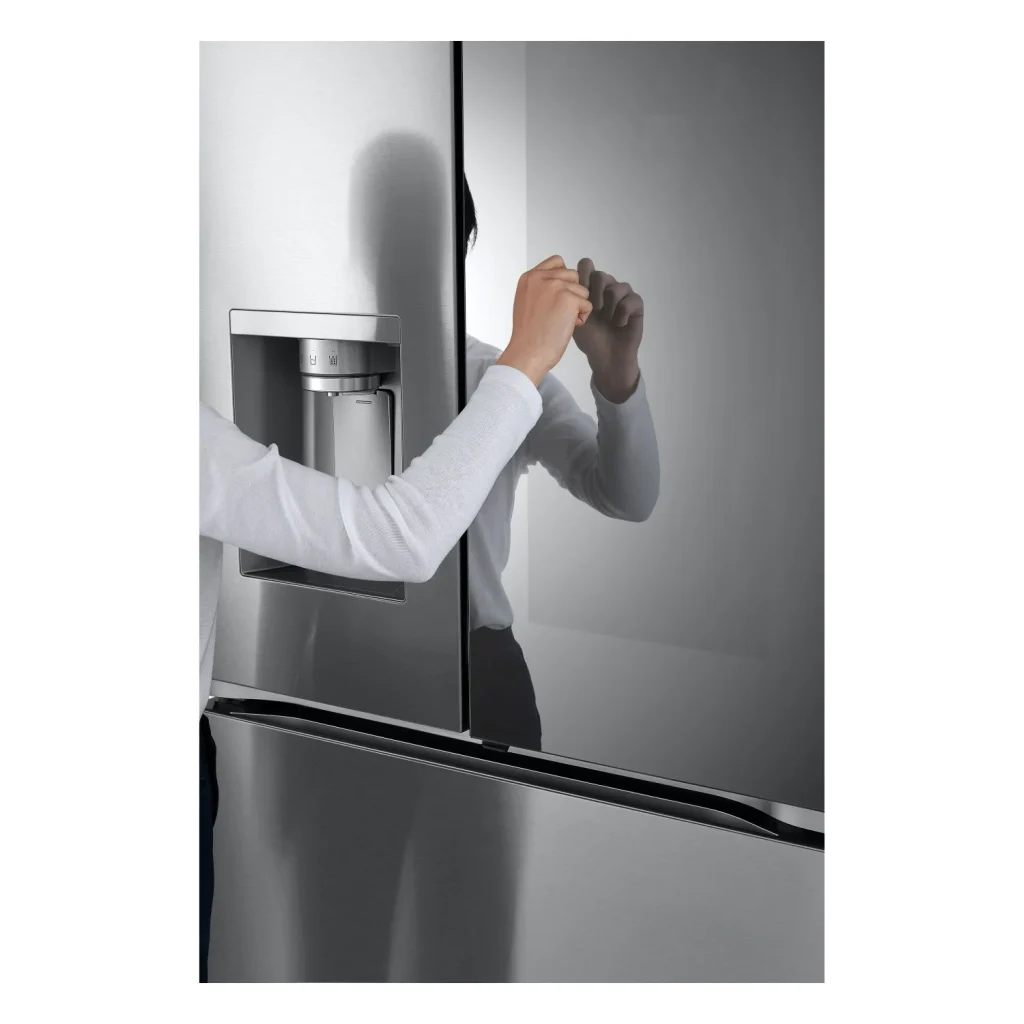
You’re mid-recipe, hands covered in flour, or oil, or something you don’t want on a door handle. The timer’s running. You just need to know one thing: is there still butter in there, or do you need to grab the last bottle of juice before it’s gone?
Most people stop what they’re doing, wipe their hands, and open the door anyway. LG built the InstaView Door-in-Door around a different answer: don’t open it. Knock.
Two Knocks, That’s All
The InstaView panel is a fully tinted glass window built into the fridge door. Knock twice, and a light switches on inside, letting anyone see what’s on the shelves without touching the handle, without opening the door, and without the cold air escaping that would otherwise happen every time. On the flagship 635-litre side-by-side model, a smaller door compartment sits alongside the main panel, built for the items people reach for constantly, milk, cheese, snacks, so a quick grab doesn’t mean opening the full door and releasing all the cold air behind it.
A Fridge That Cools Itself Evenly
Behind the glass, LG’s engineering focus is on keeping temperature consistent everywhere inside the fridge, not just on the main shelves. A feature called DoorCooling+ is designed to bring the inside temperature down 35 percent faster than a conventional cooling system, based on LG’s own testing, specifically narrowing the usual gap between the cold centre of the fridge and the comparatively warmer door area. A separate feature, LINEARCooling, is aimed at reducing the small temperature swings that happen every time a compressor cycles, with LG’s internal testing suggesting this can help lock in freshness for up to seven days on applicable models.
Cleaner by Design
LG has also built specific hygiene features into the InstaView range. HygieneFresh+ is designed to reduce bacteria activity inside the fridge by up to 99.99 percent and cut down acidic and alkaline odours, a claim confirmed by Intertek under the ISO 27447 test protocol, tested against four specific bacteria strains including E. coli and Listeria monocytogenes. On the side-by-side InstaView models, a feature called UVnano is built into the water dispenser itself, using UV LED light to keep the dispenser nozzle, a part of the fridge that almost never gets manually cleaned but handles drinking water daily, sanitised between uses.
A Fridge You Can Check From Your Phone
The InstaView range connects to LG’s ThinQ app, letting someone set the fridge’s temperature, control HygieneFresh+, and run diagnostics from their phone, whether they’re upstairs or out of the house entirely. For a fault that needs more than an app can catch, LG’s Smart Diagnosis service lets someone call the customer helpline and place a phone against the appliance itself; the fridge communicates directly with LG’s diagnostic system and returns a result within seconds
Powered Efficiently
None of this is much good if it comes with a painful electricity bill. That’s why LG refrigerators are equipped with the Smart Inverter Compressor, which intelligently adjusts cooling performance based on actual usage rather than operating at a constant speed. This helps reduce energy consumption while delivering quieter operation, improved durability, and more consistent cooling. Combined with Linear Cooling™ technology, it minimizes temperature fluctuations to help keep food fresher for longer, offering consumers greater efficiency and peace of mind.
LG backs the compressor with a ten-year parts warranty, a length of cover unusual enough in the appliance market to function as its own kind of confidence statement. Layered on top of that, every knock that replaces an open door means less cold air escapes, and less work for that same compressor to do to recover it.
Sizing It to the Household
LG’s own buying guidance for the East African market ties capacity to household size rather than treating bigger as automatically better: fridges under 450 litres are usually enough for one or two people, bottom or top freezer models between 300 and 500 litres suit a family of three to four, and side-by-side models of 500 litres or more are aimed at larger households needing wider storage for trays or platters. The flagship InstaView side-by-side sits at 635 litres, comfortably in that larger-household range, with a smaller 349-litre InstaView bottom freezer model available for more modest kitchens.
The Bigger Picture
None of these features change what a refrigerator fundamentally does. What they change is how much thought a household has to put into managing it, whether that’s a compressor doing less work because a door opened less, a dispenser nozzle staying sanitised without anyone remembering to clean it, or a phone call that diagnoses a fault before it becomes an expensive one. The knock on the glass is the most visible feature here. Everything it prevents, an open door, escaping cold air, a harder-working compressor, is where the real saving actually happens.



More Stories
Coopbank ranked among the Best Performing Banks in the World by Forbes
Best ICT Attachment Opportunities in Kenya 2026/ Newsline Media and Training Agency
Computer Science Attachment Opportunities 2026 | Newsline Media