

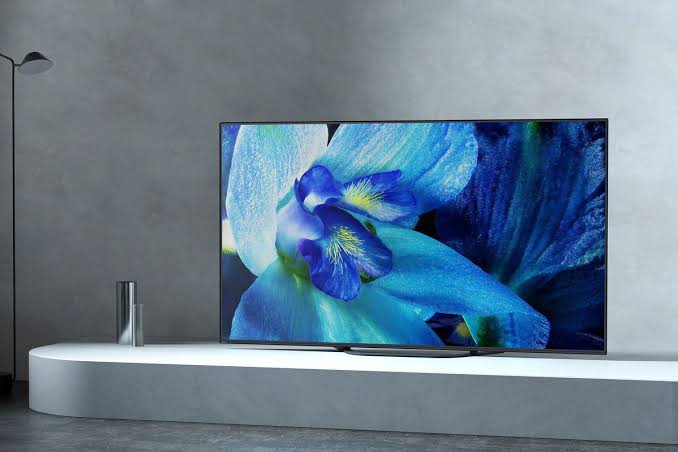
A decade ago, buying a television meant comparing screen size and picture quality, and not much else. Today’s televisions do something different. They can tell what is on screen, and change how they show it, without anyone touching a remote.
This shift started with a simple idea: switch off the light where you don’t need it. Older televisions use a backlight that stays on across the whole screen, even during a dark scene.
OLED televisions work differently. Each pixel is made from organic compounds that light up on their own when a small electric current passes through them, so every point on the screen can switch fully on or off by itself, with no backlight involved.
When a scene goes dark, it actually goes dark, not just dim. This also lets manufacturers build thinner, more flexible screens without giving up picture quality or viewing angle.
That one idea has kept LG at the top of the television market for years. According to independent tracking by the research firm Omdia, LG has sold more OLED TVs than any other brand for twelve years running, from 2013 to 2026.
Proof, Not Just Promises
Anyone can say their television has good colour and deep black. LG’s OLED sets have been independently checked. A body called UL has verified that LG’s screens produce true black, tested under normal indoor lighting of 200 to 500 lux. A separate company, Intertek, has confirmed that LG’s OLED TVs, across both 4K and 8K models, show the full range of colour a film was originally shot in, rated at 100% Colour Fidelity and 100% Colour Volume to the DCI-P3 standard.
A Screen That Adjusts Itself
The bigger change is what happens behind the screen. Modern LG OLED TVs use built-in processors that look at what is playing and adjust the picture and sound to match it, switching between sharper motion for sport, richer colour for movies, and clearer voices for news, without the viewer opening a settings menu.
Additionally, sound gets the same treatment. A feature called AI Sound Pro changes the audio in real time, so a loud action scene and a quiet conversation each come through the way they should.
The top model in the range, the LG OLED evo G5, takes this furthest. It uses the Alpha 11 AI Processor Gen2 with AI Picture Pro to read over 8.3 million pixels on the screen at once to sharpen detail, and its Brightness Booster Ultimate can push brightness up to three times higher than earlier non-evo models.
None of this only happens on the screen itself. LG’s webOS software puts streaming apps such as Netflix, Disney+ and YouTube within a few clicks of the remote, and a multi-View feature lets someone watch one thing while browsing or gaming on the same screen at the same time.
Built for Gamers Too
Gaming has pushed this technology further than most other uses. LG’s OLED range is built to work with two industry standards for smooth gaming, G-SYNC and FreeSync, with variable refresh rates up to 165Hz and response times as fast as 0.1 milliseconds, reducing motion blur and screen tearing during fast-paced games.
The range also carries features aimed specifically at console and PC gamers, including automatic low-latency switching and quick frame transitions, alongside ClearMR 10000 certification from VESA, an industry body that independently tests motion-blur performance.
Two Ranges, Different Priorities
Not every household needs an OLED set. LG’s own comparison points buyers toward its premium LCD range, QNED, for those who want rich colour and clarity, and it is well suited to sports fans thanks to a wider choice of large screen sizes. All 2026 QNED models carry the same 100% Colour Volume certification as the OLED range.
The distinction, in LG’s own framing, comes down to environment and priority: OLED for cinematic depth, QNED for a bigger, brighter room.
What This Means for Viewers
None of this changes what people watch. It changes how effortless watching it has become. A television that used to simply display whatever was fed into it now reads the scene, adjusts for it, and gets out of the way.
Whether that counts as “smart” is a matter of opinion. What isn’t in question is that the numbers behind it, the depth of black, the accuracy of colour, the speed of response, have all been checked by outside bodies rather than taken on LG’s word alone. That is likely why one idea, the self-lit pixel, has managed to hold its lead in a market that changes almost every year.



More Stories
Coopbank ranked among the Best Performing Banks in the World by Forbes
Best ICT Attachment Opportunities in Kenya 2026/ Newsline Media and Training Agency
Computer Science Attachment Opportunities 2026 | Newsline Media