

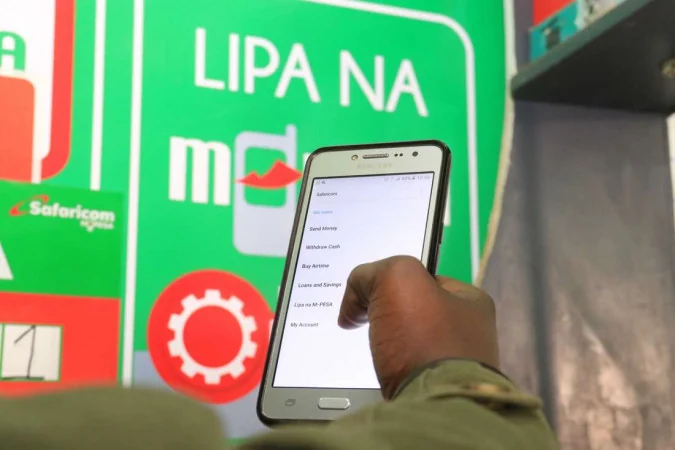
Safaricom has introduced M-PESA Jumbe, a payment notification feature designed to change how businesses confirm customer payments while reducing the amount of personal financial information shoppers have to disclose.
The service, also known as Split Notifications, allows merchants to send payment alerts directly to authorised employees while customers receive a separate confirmation message that can be used as proof of payment without displaying their full names, phone numbers or M-PESA balances.
The feature targets a familiar situation in Kenyan supermarkets, restaurants, petrol stations and retail outlets where customers are asked to display their M-PESA confirmation messages before collecting purchases.
The request, commonly expressed as “Nionyeshe message yako” (show me your message), often occurs when a business receives payment notifications on the owner’s phone, leaving attendants unable to independently confirm transactions.
Through Jumbe, Safaricom is seeking to address this operational gap by giving authorised employees access to payment notifications on their own mobile phones.
The development comes as M-PESA continues to play a central role in Kenya’s cashless economy, with mobile payments increasingly used for everyday purchases and business transactions.
How M-PESA Jumbe Works for Businesses
Under the new arrangement, businesses using eligible Lipa na M-PESA Till and PayBill numbers, as well as Pochi la Biashara, can nominate employees to receive transaction notifications directly.
Safaricom allows businesses to nominate up to 50 employees, although each individual must accept an invitation before receiving payment alerts.
The notifications contain transaction details such as the amount paid, transaction reference, business name, payment number, date and time.
This means an attendant serving a customer can receive payment information directly instead of repeatedly contacting the business owner to confirm whether money has been received.
For instance, when a customer pays at a supermarket checkout, an authorised cashier can receive the transaction notification on their own phone and use the reference number to verify the payment.
The arrangement could be particularly useful for businesses operating several checkout counters, branches or service points where payment confirmation delays can affect customer experience.
According to People Daily’s report on Safaricom’s Split Notifications feature, the system is intended to reduce the need for employees to depend on customers’ phones or contact business owners whenever a payment is made.
How Jumbe Could Help Reduce Payment Fraud
Payment verification remains an important responsibility for businesses that accept mobile money.
In some situations, attendants may be presented with a payment confirmation message but lack an independent way of establishing whether the transaction has reached the merchant’s account.
This can create disagreements between customers and employees, particularly where a transaction is delayed or its authenticity is questioned.
By sending transaction alerts directly to authorised employees, Jumbe provides businesses with an additional channel for checking payments.
Employees can compare the transaction reference and amount received against the payment information presented by the customer.
The transaction reference is particularly important because it helps distinguish individual payments, including transactions involving similar amounts.
However, Jumbe should not be treated as a complete solution to M-PESA fraud. Businesses must continue checking authorised notifications and official payment records before releasing goods or completing services.
Why M-PESA Jumbe Matters for Customer Privacy
Beyond payment verification, the feature addresses concerns about the personal information customers routinely expose when asked to show their M-PESA messages.
An ordinary M-PESA confirmation SMS can contain the customer’s full name, phone number and account balance, details that may not be necessary for an attendant to establish whether a purchase has been paid for.
Jumbe introduces a separate confirmation message designed to reduce this exposure through an abbreviated customer identifier known as JumbeID.
The identifier replaces the customer’s full name and phone number with a shortened reference, while retaining transaction information needed to identify the payment.
According to TechTrendsKE’s explanation of M-PESA Jumbe and its privacy features, the JumbeID uses the customer’s initials and the final two digits of their phone number.
The separate message also excludes the customer’s M-PESA balance and full phone number.
However, JumbeID should not be confused with complete anonymity because it still uses an abbreviated identifier derived from customer information.
The development is relevant to Kenya’s wider data protection framework, which places obligations on organisations handling personal information. More information is available in Safaricom’s Data Privacy Statement.
How Customers Can Use M-PESA Jumbe
Customers do not need to register or activate Jumbe themselves.
Once they make a payment to a business that has enabled the feature, they receive a separate Jumbe confirmation SMS alongside the ordinary M-PESA transaction message.
They can then show the separate confirmation to the attendant as proof of payment without necessarily displaying their full transaction message.
The Jumbe confirmation contains the transaction reference, amount paid, business name, payment number, date and time.
However, the service depends on merchant activation. Customers paying businesses that have not enabled Jumbe will continue receiving the usual M-PESA confirmation message.
This means shoppers should not assume that every Till or PayBill transaction will automatically generate a separate Jumbe notification.
How Businesses Can Activate M-PESA Jumbe
Business owners and administrators can activate the service by dialling *234# on their Safaricom lines, selecting the M-PESA Jumbe option and following the instructions to nominate employees.
They can also access the service through the M-PESA Business Hub.
After entering the mobile numbers of the employees they wish to authorise, business administrators must wait for the nominated staff members to receive and accept their invitations before notifications begin.
Safaricom allows businesses to nominate up to 50 employees to receive the alerts.
The arrangement is designed to give employees access to the transaction details needed for payment verification without granting them access to the business owner’s M-PESA balance, PIN, statements or transaction history.
Business owners can therefore delegate payment confirmation responsibilities while retaining control over their wider financial accounts.
What M-PESA Jumbe Changes for Kenyan Shoppers
The introduction of Jumbe addresses a routine but often overlooked challenge in Kenya’s growing cashless economy: the gap between making a payment and having a merchant independently confirm receipt.
For customers, the feature offers a more private way of proving that they have paid without exposing unnecessary personal financial details.
For businesses, it creates an opportunity to improve service delivery by allowing authorised employees to receive payment notifications directly.
Its effectiveness will depend on how widely merchants adopt the feature and how consistently employees use the transaction references to verify payments.
For now, customers shopping at businesses that have activated Jumbe may have a simpler response the next time an attendant asks, “Nionyeshe message yako”: show the separate Jumbe confirmation instead of exposing the full M-PESA transaction SMS.




More Stories
Cledun Realtors Announces Black November Deals With KSh50,000 Discount on Wema Court Phase II
Court Sentences Mackenzie to 200 Years in Prison Over Shakahola Deaths
Kalonzo Demands Special Inquiry into Homa Bay Rally Violence, Claims 61 Killed