

Kenya’s coastal property market is experiencing a major boom, with land prices in top beach towns such as Diani and Watamu rising by more than 70 per cent since the Covid-19 pandemic as demand for lifestyle living gains momentum.
A new Coastal Land Price Index released by HassConsult shows that the Coast is increasingly attracting remote workers, retirees, diaspora investors and long-stay visitors seeking permanent or semi-permanent homes away from major cities.
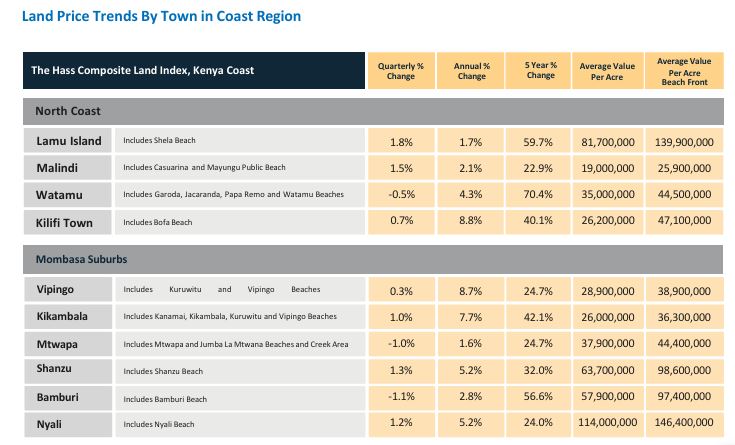
The report reveals that Diani recorded the highest five-year land price growth at 79.1 per cent between 2020 and 2025, followed closely by Watamu at 70.4 per cent. Lamu and Bamburi also posted strong gains of 59.7 per cent and 56.6 per cent respectively.
According to HassConsult, the shift marks a major transformation in Kenya’s coastal real estate market, which is now being driven less by tourism and more by lifestyle migration and remote working trends that accelerated after the pandemic.
“Coastal land has delinked from general economic trends in Kenya on new dynamics during the 2020s,” said Sakina Hassanali, Co-CEO and Creative Director at HassConsult.
“Across remote working, retirement relocation, and the long tail of international and domestic buyers who first discovered the Coast as tourists, it has developed its own, distinct land dynamics.”
The report introduces the concept of a “beauty premium”, where areas with wider beaches, ocean views and attractive landscapes are commanding significantly higher prices.
Nyali remains the Coast’s most expensive area with land averaging Sh114 million per acre, while beachfront plots in the suburb attract a 19 per cent premium over the wider area average.
HassConsult noted that towns with exceptional natural scenery and better lifestyle amenities have experienced the strongest demand, while areas with weaker infrastructure, water shortages and land ownership disputes continue to lag behind.
Kilifi Town emerged as the fastest-growing market in 2025 with annual land price growth of 8.8 per cent, while Mombasa City recorded the weakest annual performance after prices dipped by 1.03 per cent.
Meanwhile, areas such as Vipingo and Malindi posted slower growth rates of about 25 per cent over the five years, reflecting lower investor interest due to weaker aesthetics and limited facilities.
The report also warned that unresolved land title issues and unreliable water supply are discouraging some buyers from investing in parts of Kilifi and Kwale counties.
“Professionals moving to the Coast to work remotely, or relocating from all over the world to enjoy leisured retirements, simply will not buy when land titles are uncertain or water precarious,” said Ms Hassanali.
Overall, the Hass Coast Land Index recorded a 40.7 per cent increase in land prices over the past five years, highlighting the growing appeal of Kenya’s coastline as a prime residential and investment destination.




More Stories
Roam raises local content in electric motorcycles to 40%, targets 50% by 2027
Workable Becomes Africa’s First Coworking Space to Earn WELL Health Rating
How Kindiki is mirroring Ruto’s 2022 playbook to rebuild UDA’s Mt Kenya support