

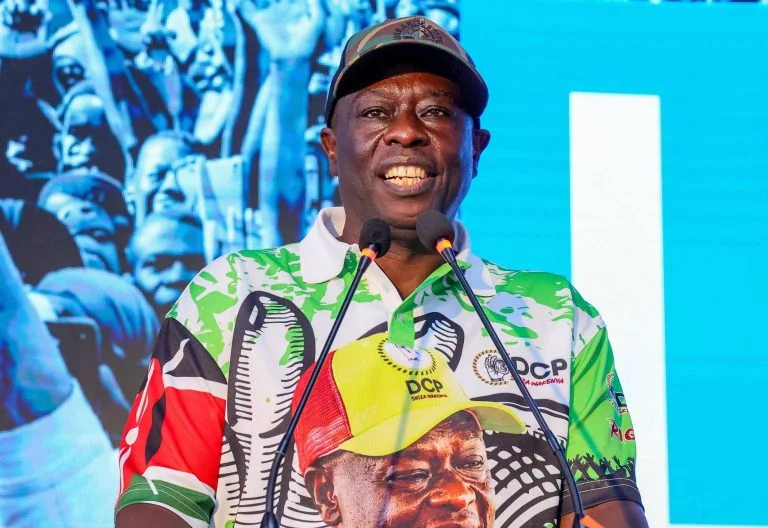
Former Deputy President Rigathi Gachagua is heading into one of the most consequential political tests of his career as he attempts to transform the Democracy for the Citizens Party (DCP) into a formidable political organisation ahead of the 2027 General Election.
Since unveiling DCP on May 15, 2025, Gachagua has sought to position the outfit as an alternative political home for leaders opposed to President William Ruto’s administration, particularly in the Mt Kenya region, where the political fallout following his impeachment reshaped alliances.
However, building a political party around a popular political figure is one thing; managing the competing interests of politicians seeking its tickets, leadership positions and influence is another.
As the 2027 elections approach, DCP is increasingly being confronted with questions about internal democracy, party loyalty, nomination procedures and the balance between established allies and new entrants.
The emerging disagreements could test Gachagua’s ability to manage a political organisation whose ambitions extend beyond his immediate political circle.
The growing pressure within DCP
One of the biggest challenges facing Gachagua is managing the expectations of politicians who joined his political movement during its formative stages.
Some of his early allies stood with him during his fallout with President Ruto, publicly defended his political positions and helped establish grassroots networks for the new party.
However, the entry of other politicians seeking DCP tickets has introduced another dimension to the party’s internal politics.
The question of who deserves priority when nominations arrive could become a difficult balancing act for the party leadership.
Established politicians may expect their loyalty and contribution to the formation of DCP to count for something, while newcomers could argue that their popularity, grassroots networks and electoral strength should determine who receives party tickets.
This tension was highlighted in January 2026 when The Star reported that nomination disputes were emerging within DCP, with early loyalists concerned that their contribution could be overshadowed by new entrants.
Former Kigumo MP Jamleck Kamau, who had expressed interest in the Murang’a gubernatorial seat, announced that he was stepping back from active politics.
The development illustrated the challenges facing a relatively young political party attempting to accommodate politicians with different ambitions and expectations.
The nomination question that could divide the party
Perhaps the most sensitive issue facing Gachagua is how DCP will conduct its nominations.
In July 2026, the party leader publicly maintained that candidates would have to compete for elective positions rather than receive direct tickets.
His position was intended to demonstrate a commitment to competitive nominations, including in constituencies represented by his political allies.
However, the promise also introduces a difficult political reality.
Some incumbent leaders who have supported Gachagua’s political movement may find themselves competing against newcomers seeking the same positions under the DCP ticket.
The Daily Nation reported in October 2026 that some aspirants were questioning whether the party’s promise of open nominations would be implemented consistently, with concerns about alleged preferential treatment and endorsements by senior officials.
The dispute touches on a fundamental question: can a party leader publicly support particular aspirants while maintaining confidence among other candidates that the nomination process will be fair?
For Gachagua, the answer will have implications beyond individual parliamentary contests.
In a region where party tickets carry considerable political significance, disputed nominations could leave unsuccessful aspirants considering independent bids or alternative political platforms.
That possibility makes internal dispute resolution and transparent candidate-selection procedures particularly important.
The Mt Kenya leadership question
Beyond party nominations, Gachagua faces the broader task of organising political leadership in the Mt Kenya region.
The region has several established political figures with their own support bases, ambitions and constituencies.
Some are seeking parliamentary positions, others are eyeing gubernatorial and senatorial seats, while a section of younger politicians is looking to establish itself in county and national politics.
Bringing these interests under one political umbrella requires a delicate arrangement.
The challenge becomes more complicated when politicians who previously supported different political formations begin moving towards DCP, each bringing their own expectations about leadership and political influence.
The party must also contend with the question of whether its political direction should be determined primarily by Gachagua’s inner circle or through broader consultation involving elected leaders, grassroots representatives and party officials.
These questions will shape how DCP organises itself as it seeks to consolidate its support in Mt Kenya.
Coalition politics adds another layer
Gachagua’s political ambitions are also unfolding against the background of negotiations among opposition parties seeking to establish a common political platform ahead of 2027.
The former deputy president has indicated that DCP wants to strengthen its own political structures before entering formal coalition negotiations.
That position places emphasis on building the party’s grassroots presence, recruiting influential politicians and establishing its bargaining position within the opposition.
However, coalition politics could introduce difficult questions about how political parties share elective positions.
If DCP enters an electoral arrangement with other parties, it may have to negotiate constituency-level interests, parliamentary representation and the distribution of political opportunities.
Such arrangements could create competing demands between DCP aspirants and politicians from allied formations.
The September 2026 unveiling of the Ukombozi Alliance, associated with Wiper leader Kalonzo Musyoka and other opposition figures, has further highlighted the question of how opposition parties intend to coordinate their 2027 strategies.
For Gachagua, building DCP independently while maintaining relationships with other opposition leaders presents an organisational and political balancing act.
The UDA experience and lessons from 2022
Gachagua’s experience in UDA offers an important historical reference point.
In 2022, the party attracted numerous aspirants seeking tickets across the country as William Ruto consolidated his political support ahead of the August General Election.
However, its nominations were accompanied by complaints, disputed results and accusations of irregularities in different parts of the country.
The experience demonstrated that political popularity does not automatically translate into smooth internal party processes.
Even a party with a strong national political mobilisation structure can struggle to manage the expectations of competing aspirants.
DCP now faces a related organisational challenge as it seeks to expand its influence and attract politicians from different political backgrounds.
The party will need credible nomination rules, transparent dispute-resolution mechanisms and clear communication about how candidates will be selected.
Without such structures, disagreements over tickets could become a source of political fragmentation.
Can Gachagua balance loyalty and political expansion?
At the centre of DCP’s emerging challenges is Gachagua’s ability to balance two competing objectives: rewarding the politicians who helped establish his political movement and opening the party to influential newcomers who could strengthen its electoral reach.
Restricting entry could limit the party’s ability to attract established political figures, while accommodating every new entrant without clear rules could generate resentment among founding members.
The dilemma is not unique to DCP. Political parties seeking rapid expansion frequently encounter tensions between established members and politicians joining with existing political influence.
However, for a party whose public identity is closely associated with one prominent leader, internal disagreements could quickly become questions about the leader’s authority and organisational direction.
Gachagua must therefore establish structures that allow party members to compete without every disagreement becoming a confrontation involving the party leadership.
The battle for DCP is ultimately about more than securing elective positions in 2027. It is about building a political institution capable of managing internal competition, accommodating different interests and maintaining a coherent political identity.
As the country moves closer to the next General Election, Gachagua’s leadership will increasingly be measured not only by the politicians he attracts but also by how his party handles those who disagree, lose nominations or seek alternative political arrangements.
The question facing DCP is whether it can turn its growing political ambitions into a structured organisation without allowing the competition for power within its ranks to overshadow the wider political project.
For Gachagua, 2027 will not only be a contest against political rivals. It will also be a test of how he manages the party he has built.



More Stories
Safaricom Home Internet: Get 40Mbps at KSh 3,749
Mogo, RSC and ZTE Partner to Expand Affordable Smartphones in Kenya
Kingdom Bank Opens 30th Branch in Nairobi CBD as It Expands Banking Services