

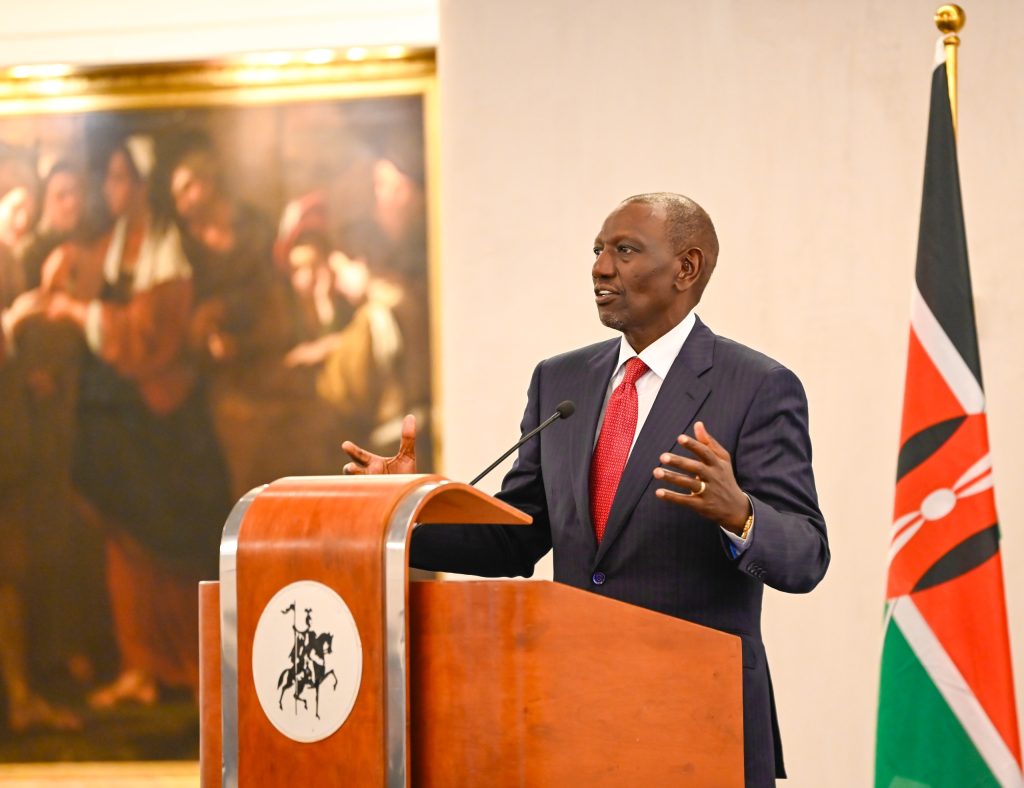
The United Democratic Alliance (UDA) is stepping up grassroots mobilisation and internal party organisation as political parties position themselves for the 2027 General Election, placing renewed focus on how the ruling party plans to consolidate its support ahead of the contest.
The party has been holding aspirants’ meetings, strengthening its grassroots structures and publicly emphasising internal party democracy, while President William Ruto and senior UDA officials seek to project an organised political movement heading into the election year.
The renewed mobilisation comes as opposition parties attempt to consolidate several political formations into a broader alliance, with leaders from different parties holding consultations over a common strategy.
UDA’s strategy has included bringing together prospective candidates and elected leaders as the party prepares for the 2027 nominations.
In February, the party said more than 12,000 aspirants had been brought together at State House as part of preparations for the elections, with Ruto assuring them that UDA nominations would be free, fair and democratic.
During a recent aspirants’ meeting, Ruto reiterated his commitment to transparent nominations, saying candidates would have an opportunity to compete without being locked out because of financial constraints.
“Our commitment to transparent internal party processes is the bedrock of our party’s strength,” Ruto said.
UDA Secretary General Hassan Omar Hassan has similarly sought to portray the party as a long-term political organisation rather than an electoral vehicle created for a single election.
“UDA is not a moment, but a movement that is here to stay,” Hassan said.
National Chairperson Cecily Mbarire has also maintained that the party remains united and focused on delivering under Ruto’s leadership.
JKUAT lecturer and political strategist Charles Mwangi said the party’s recent activities were part of a deliberate attempt to strengthen its structures and create a perception of an active and organised political movement.
“The UDA strategy is high-tech. The recent activities you see are mostly aimed at creating an image among supporters that the party is active and alive, especially in areas where it had received rejection. It is actively reclaiming lost supporters, strengthening local party structures and projecting unity,” Mwangi said.
He argued that Ruto’s promise of transparent nominations could also influence how sections of the electorate perceive the ruling party, particularly in areas where internal party disputes have previously generated dissatisfaction.
Mwangi said a sustained grassroots operation could energise UDA supporters and give the party an organisational base from which to campaign for Ruto’s re-election.
Opposition seeks to consolidate
While UDA has been strengthening its internal structures, opposition parties have been working on a parallel effort to bring different political formations under a common umbrella.
The former Azimio la Umoja coalition has undergone a series of organisational changes as opposition leaders seek to build a broader political platform ahead of 2027.
In September, the coalition announced plans to rebrand and expand its membership, with Secretary General Caroli Omondi saying the changes were intended to strengthen the opposition’s organisation ahead of the election.
The coalition subsequently rebranded as the Ukombozi Alliance, with Wiper leader Kalonzo Musyoka announcing that the change had been unanimously approved by the parties involved. Former President Uhuru Kenyatta was initially announced as chairman of the rebranded alliance.
The developments followed earlier changes in the coalition’s leadership, including the appointment of Kalonzo as party leader and Omondi as secretary general.
The opposition’s broader strategy has also involved engagement with political parties and leaders outside the original coalition.
A resolution of the coalition’s Joint Council and National Executive Committee authorised Kalonzo to engage with other political formations, including Rigathi Gachagua’s Democracy for Citizens Party and Martha Karua’s People’s Liberation Party.
These efforts have coincided with increased political activity by Gachagua, Kalonzo, Karua, Fred Matiang’i and Eugene Wamalwa, among other opposition figures.
ODM Secretary General Edwin Sifuna has meanwhile continued to reject suggestions that his party could be compelled into a pre-election arrangement with Ruto.
“Nobody can compel me to vote for William Ruto. Knowing what I know about how Kenyans vote, from Western to Coast, Nyanza, Central Kenya, Eastern, I simply do not see a path to power for William Ruto,” Sifuna said.
Sifuna has appeared alongside several opposition leaders at public events as the various parties seek to establish a common political position ahead of 2027.
Mt Kenya becomes key battleground
The political contest has been particularly pronounced in the Mt Kenya region, where both UDA and opposition leaders are seeking to strengthen their networks.
Kiambu Assembly Minority Leader Joe Kigara said opposition parties were also reorganising and argued that UDA’s recent activities should not automatically be interpreted as a shift in voter sentiment.
“It’s too early to speculate on who will be elected or which party is stronger. Let’s focus on service delivery instead of engaging in unhealthy politics,” Kigara said.
Gatanga MP Edward Muriu, an ally of Gachagua, has meanwhile argued that political support in Mt Kenya has shifted away from the Ruto administration.
“Ruto betrayed the people who supported him in 2022. Winning back that support will be extremely difficult,” Muriu said.
Gachagua has been particularly vocal in presenting Mt Kenya as an important component of the opposition’s strategy.
Speaking during recent political engagements, he said the region would organise around a common political position and that his camp would prioritise voter registration and turnout.
“Our priority is registration and turnout. These voters have already decided,” Gachagua said.
He has also dismissed reports of defections from his political camp, describing the movement of politicians between parties as part of an ongoing political “transfer window.”
“This is the transfer window. In the next two months, all the spies will be removed to where they came from,” Gachagua said.
His remarks reflect the fluid nature of political alignments as parties attempt to determine which leaders and networks will form part of their 2027 campaigns.
Rival narratives emerge
The competing mobilisation efforts have produced sharply different narratives about the state of the political landscape.
UDA leaders say the party is strengthening its structures, preparing candidates and creating a more organised grassroots network.
Opposition leaders, meanwhile, argue that dissatisfaction with the government’s record will create space for a broader political coalition.
At a church service in Murang’a County, opposition leaders including Kalonzo, Karua, Gachagua, Matiang’i, Justin Muturi and Wamalwa called for greater unity and criticised the Ruto administration over the cost of living, healthcare and education.
Matiang’i said the opposition’s immediate priority was to remove the current administration from power regardless of which individual ultimately emerges as the coalition’s presidential candidate.
“What matters is sending this regime home,” Matiang’i said.
Kalonzo has similarly criticised the government’s record while positioning himself as one of the senior figures involved in the opposition’s efforts to build a common political platform.
UDA also faces internal challenges
Despite its renewed mobilisation, UDA’s organisation has not been without challenges.
Several politicians associated with the ruling party have shifted their political positions, particularly in Mt Kenya, while others have publicly questioned aspects of the government’s leadership.
The movement of politicians between UDA, DCP and other parties has become part of the broader political realignment ahead of 2027.
Githunguri MP Gathoni Wamuchomba, whose political positioning has shifted in recent years, remains listed as a UDA member on the National Assembly’s official website.
Her political positioning has nevertheless continued to attract attention, with recent reports highlighting her changing relationship with both Ruto’s administration and Gachagua’s camp.
The wider movement of politicians has made party structures and grassroots networks increasingly important as the major political formations prepare for nominations and coalition negotiations.
The battle ahead
The emerging contest is therefore taking shape on two parallel fronts.
UDA is focusing on strengthening its party machinery, preparing aspirants and demonstrating organisational activity across the country.
The opposition is attempting to consolidate parties with different ideological backgrounds, political interests and presidential ambitions into a common electoral platform.
Neither strategy has yet resolved the larger question of how the competing formations will translate their organisational efforts into votes in August 2027.
For UDA, the challenge will be maintaining cohesion while managing competing ambitions within the party and responding to political movements in regions where its support has come under pressure.
For the opposition, the challenge will be turning its multiple alliances and consultations into a coherent political structure capable of surviving competing presidential ambitions.
With the election still ahead, the battle is increasingly moving from public rallies and political declarations to the less visible work of building party structures, recruiting candidates, registering voters and negotiating coalition arrangements.
The months ahead are therefore likely to determine not only which parties dominate the political conversation, but also whether the rival camps can convert their growing organisational activity into durable political alliances before the 2027 campaign enters its final phase.

More Stories
How Uhuru’s ‘Yangu Kumi, Ya Ruto Kumi’ Promise Still Shadows Ruto’s 2027 Bid
Co-operative Bank Partners with EBRD on a Landmark US$100 Million Currency Swap to Expand Access to Competitive Foreign Currency Financing
Co-op Bank Partners With Fanaka Real Estate to Expand Homeownership Financing