

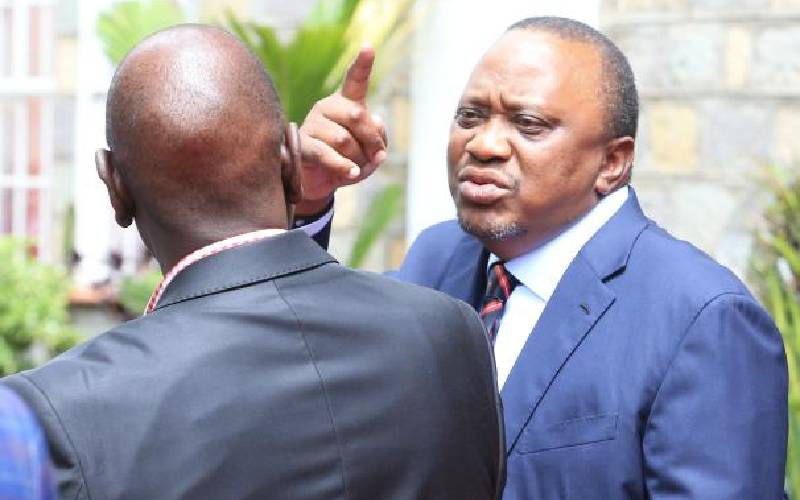
More than a decade after Uhuru Kenyatta and William Ruto joined forces to win the 2013 presidential election, their famous “Yangu kumi, ya Ruto kumi” declaration has resurfaced as one of the reference points in the political debate surrounding Ruto’s 2027 re-election bid.
The phrase, loosely translated as “ten years for me, ten for Ruto”, came to symbolise the political understanding that brought the two former rivals together under the Jubilee alliance ahead of the 2013 election.
Uhuru was seeking the presidency, while Ruto, who had previously been on the opposite side of the political divide, became his running mate.
The partnership delivered victories in both the 2013 and 2017 presidential elections, giving the two leaders a decade-long political partnership that would later collapse spectacularly.
Today, however, the old declaration is being viewed through a completely different political lens.
Ruto’s allies have increasingly invoked the Jubilee-era arrangement as they seek to mobilise support for the President in Mt Kenya, arguing that the region should recognise the political support Ruto offered Uhuru during his two terms.
But the argument has also opened a broader question: if the region is being asked to honour an old political commitment, what does it expect in return in 2027?
That question has placed Deputy President Kithure Kindiki at the centre of the emerging debate over Ruto’s running mate.
Kindiki and the Mt Kenya question
The Service Party leader Mwangi Kiunjuri has argued that the Deputy President position should remain with Mt Kenya and should not be treated as a bargaining chip in negotiations with other regions.
Speaking to Inooro FM, Kiunjuri said he would not support the Kenya Kwanza administration if Ruto removed Kindiki from the 2027 ticket.
“If they try to touch the position of Kithure Kindiki, I will do away with them. If the slot of Deputy President won’t be from Mt Kenya, I will not support the Kenya Kwanza administration,” Kiunjuri said.
His position has added another layer to the debate over whether Mt Kenya’s political expectations in 2027 should be defined by the old Uhuru-Ruto understanding, the retention of Kindiki or broader regional interests.
Political analyst Prof Macharia Munene, however, has argued that Ruto has grounds to remind the region of the commitment made during the Jubilee era.
“Ruto can demand what was publicly promised to him because he played his part by supporting Uhuru for the full ten years. Political differences that came later should not erase that commitment,” Munene told The Star.
Munene also described Kiunjuri’s position on Kindiki as tactical politics ahead of the 2027 contest.
“Kiunjuri is playing safe and tactical politics by invoking Kindiki. He is simply seeking an escape route after sensing that UDA is losing ground in Laikipia,” Munene said.
But voters in the region have offered a different interpretation of the old agreement.
Ann Nyambura, a Kiambu voter, said the political understanding between Uhuru and Ruto should not automatically bind today’s electorate.
“Those were agreements made by politicians more than a decade ago. Today, voters have their own realities. We are looking at the cost of living, jobs, businesses and development. That is what will shape our decision in 2027, not a political promise made in 2013,” she said.
Nyambura said Mt Kenya should enter the 2027 political negotiations with clearly defined interests rather than offering unconditional support to any political formation.
“We should not go into this election just to support somebody. Let our leaders sit down and agree on what the region wants, whether it is the Deputy President, development or opportunities for our young people. Then we can decide where our support goes,” she said.
Ruku rejects Kindiki condition
Public Service Cabinet Secretary Geoffrey Ruku has meanwhile rejected the suggestion that Mt Kenya’s support for Ruto should depend entirely on Kindiki remaining his running mate.
Ruku said the President has the constitutional prerogative to choose his running mate and maintained that supporters would continue backing Ruto even if Kindiki is not retained.
“If Kindiki is not picked, we will continue supporting President Ruto. It is the prerogative of the head of state to choose his running mate,” Ruku said.
At the same time, Ruku has personally backed Kindiki’s retention, saying the Deputy President had performed well in his current role.
The conflicting positions illustrate the political calculations surrounding the 2027 ticket: while some leaders are presenting Kindiki’s retention as a regional interest, others argue that support for Ruto should not be tied to the identity of his running mate.
Kindiki himself has urged Mt Kenya residents to remain united and resist political divisions ahead of the election.
The Deputy President has argued that political competition should not fracture communities or threaten peace, noting that elections are temporary while communities and the country remain.
“I am asking the community of Mount Kenya, let us continue staying together, as one,” Kindiki said, while citing former presidents Jomo Kenyatta, Mwai Kibaki and Uhuru Kenyatta as leaders who enjoyed broad support in the region.
Waiguru invokes the old promise
Kirinyaga Governor Anne Waiguru has been among the leaders explicitly invoking the original Jubilee understanding.
In February 2026, Waiguru urged Mt Kenya residents to support Ruto, arguing that the region should honour the commitment associated with the “Yangu kumi, ya Ruto kumi” declaration.
“Uhuru himself said ‘yangu kumi, ya Ruto kumi’. As Mt Kenya, we must honour our promise. Politics is about trust, and once you break trust, no one takes you seriously again,” Waiguru said.
But Waiguru has also acknowledged the limits of regional politics, warning that Mt Kenya cannot form a government on its own and needs national alliances to retain political influence.
Speaking after opening Kavote Dispensary in Gichugu, she cautioned residents against isolating the region politically.
“To the people of Mt Kenya, don’t put yourselves into a hole. As things stand, you are heading into a hole. We have carefully analysed the votes and the voting patterns in this region, and the numbers do not lie,” she said.
Her remarks underline the tension within the regional debate: whether Mt Kenya should approach 2027 primarily through the lens of its historical relationship with Ruto or negotiate around its current political and economic interests.
From political partners to bitter rivals
The debate over the old promise has also been complicated by the dramatic collapse of the Uhuru-Ruto relationship.
The two leaders moved from being political partners to bitter rivals during Uhuru’s second term, particularly after the 2018 handshake between Uhuru and opposition leader Raila Odinga.
Ruto subsequently built his 2022 presidential campaign around the United Democratic Alliance and Kenya Kwanza, while Uhuru backed Odinga’s presidential bid.
Their political differences have continued into the 2027 cycle.
Ruto has repeatedly criticised Uhuru’s involvement in opposition politics, arguing that the former President should have embraced the role of a statesman after leaving office.
“Mimi nashangaa, mtu ambaye amekuwa Rais wa Kenya, unaacha kiti ya Rais, badala ya kwenda kuwa statesman, unaenda kuwa rebel leader, kiongozi wa upinzani,” Ruto said recently.
The remarks came amid a fresh dispute over Uhuru’s role in Jubilee and his continued involvement in politics.
Gachagua reopens the 2022 argument
Former Deputy President Rigathi Gachagua, now aligned with the opposition Democracy for Citizens Party, has also entered the dispute, challenging Ruto’s repeated references to Uhuru’s role in the 2022 election.
Ruto has argued that Uhuru could not stop him from winning in 2022 while he was President and therefore cannot be expected to defeat him in 2027.
Gachagua has rejected that interpretation.
He argued that Uhuru’s failure to stop Ruto in 2022 did not necessarily mean that the former President’s warnings about Ruto were rejected permanently.
“President Uhuru Kenyatta did not sufficiently convince me and a majority of Kenyans that you were incapable of leading the country, that you were viciously corrupt, and that you would completely ruin our country in less than three years. Today, you have proven to me and the whole country that President Uhuru was right,” Gachagua said.
Gachagua further told Ruto that Uhuru was not his main opponent in the 2027 election, arguing that the President’s political contest would ultimately be determined by voters.
“President Uhuru Kenyatta is not your opponent in this election. You are just trying a bad deflection. Your opponents are the people of Kenya,” he said.
Is the old political debt still relevant?
The renewed debate over “Yangu kumi, ya Ruto kumi” therefore goes beyond a phrase coined during the 2013 campaign.
For Ruto’s allies, it represents an unfinished political commitment that should be recognised by the Mt Kenya region after Ruto’s support for Uhuru during his presidency.
For some leaders in the region, the focus has shifted to what Mt Kenya can secure in the next political arrangement, including the Deputy President position and other development and economic interests.
For voters such as Nyambura, however, the old agreement belongs to a different political era and cannot automatically determine how the electorate approaches 2027.
The disagreement has also exposed a wider tension within Mt Kenya politics: whether the region should approach the next election as a bloc seeking a negotiated political return, or allow voters to make choices based on contemporary concerns.
Meanwhile, the collapse of the Uhuru-Ruto partnership has given the old “ten years for me, ten for Ruto” declaration a new political meaning.
What began as a promise between two politicians more than a decade ago is now being invoked by competing sides to make different arguments about loyalty, political debt, regional interests and the future of Mt Kenya politics.
With the 2027 election still ahead, the question is no longer simply whether the old promise was made.
It is how much political weight that promise still carries among today’s leaders and voters.

More Stories
UDA’s Revival Strategy Puts United Opposition on Edge Ahead of 2027
Co-operative Bank Partners with EBRD on a Landmark US$100 Million Currency Swap to Expand Access to Competitive Foreign Currency Financing
Co-op Bank Partners With Fanaka Real Estate to Expand Homeownership Financing