

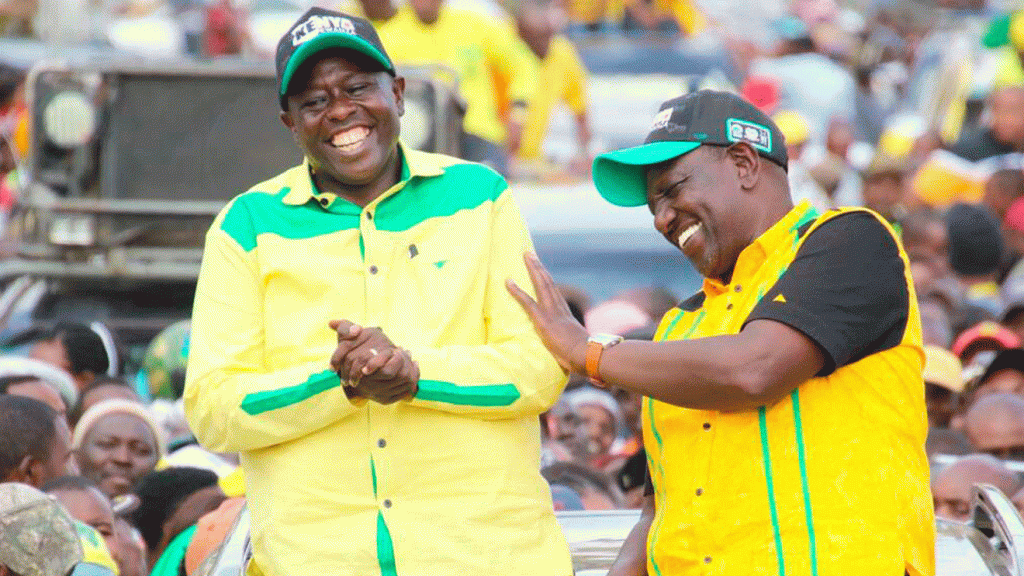
f there is one election that will be fought more in the court of public opinion than at the ballot box, it is the Ol Kalou by-election.
Ordinarily, a parliamentary by-election is a local affair driven by constituency-specific issues such as development, service delivery and the individual qualities of candidates. Ol Kalou, however, has evolved into something much bigger. It has become the first major political contest in Mt Kenya since the dramatic fallout between President William Ruto and his former deputy Rigathi Gachagua.
The constituency has therefore become a testing ground for two competing political narratives.
For the Democracy for the Citizens Party (DCP), the election represents an opportunity to validate months of political messaging. Since its formation, the party has consistently argued that President Ruto and UDA have lost the trust of Mt Kenya voters and that the region is looking for a new political vehicle. Winning Ol Kalou would allow DCP to transform that claim from rhetoric into what it would describe as electoral proof.
Such a victory would not simply be about gaining one Member of Parliament. It would be used to convince politicians across the region that the political tide has changed. Governors, Members of Parliament, Members of County Assembly and local opinion leaders often make strategic political calculations based on perceived momentum. If DCP demonstrates that it can defeat UDA in what has traditionally been a government stronghold, more leaders may feel emboldened to rethink their political loyalties ahead of the 2027 General Election.
This is why DCP is investing heavily in the race. It understands that politics is driven as much by perception as by numbers. Winning one seat can create the impression of a growing political wave, even if the broader electoral picture remains uncertain.
UDA, on the other hand, has equally compelling reasons to fight fiercely for the constituency.
Since the fallout with Gachagua, the ruling party has faced persistent claims that its support in Mt Kenya has significantly weakened. Losing Ol Kalou would reinforce those claims and provide DCP with a powerful campaign message for the next two years. It would also embolden critics who argue that UDA’s dominance in the region is rapidly eroding.
A UDA victory, however, would achieve the opposite. It would allow President William Ruto’s allies to argue that while political noise has dominated headlines, voters remain firmly behind the ruling party. The party would portray the result as evidence that development, government programmes and the advantages of incumbency still outweigh opposition rhetoric.
For UDA, retaining the seat is therefore about protecting its image as the dominant political force in Mt Kenya. Losing it would not necessarily mean the party has lost the region, but it would create a perception that its political grip is loosening—a perception that could influence future alliances and defections.
What makes the Ol Kalou contest particularly interesting is that both parties are likely to exaggerate the significance of the outcome.
Should DCP emerge victorious, it will almost certainly declare that Mt Kenya has spoken and that the region has rejected UDA. If UDA wins, it will insist that the election has confirmed its continued dominance and exposed the opposition’s claims as political propaganda.
The truth, however, is likely to be more nuanced.
Ol Kalou is one constituency with its own political history, local dynamics, candidates and voter priorities. Constituency elections are often influenced by personalities, clan considerations, local development records and campaign organisation—factors that do not necessarily reflect the political mood of an entire region.
Nevertheless, perception matters enormously in politics.
Political parties thrive on momentum. A convincing victory attracts supporters, donors, volunteers and aspiring candidates. It shapes media narratives, influences opinion polls and can even determine which politicians decide to switch sides. In many cases, perception becomes a self-fulfilling prophecy. Once a party is seen as the next political force, more leaders gravitate towards it, making that perception a reality.
That explains why the Ol Kalou by-election has attracted attention far beyond Nyandarua County. The constituency is not merely electing a new MP; it is becoming the stage upon which two political camps will seek to define the future of Mt Kenya politics.
Ultimately, whoever wins the seat will gain more than parliamentary representation. They will gain the right to shape the political narrative heading into 2027. Whether that narrative accurately reflects the mood of the entire Mt Kenya region is another question altogether, but in Kenya’s political landscape, perception is often as influential as the ballot itself.



More Stories
Kindiki warns lazy road contractors, promises stern action
Safaricom Hook Hip Hop Musical takes talent search to Kisumu
Safaricom Celebrates Kenya’s Top Photographers and Videographers