

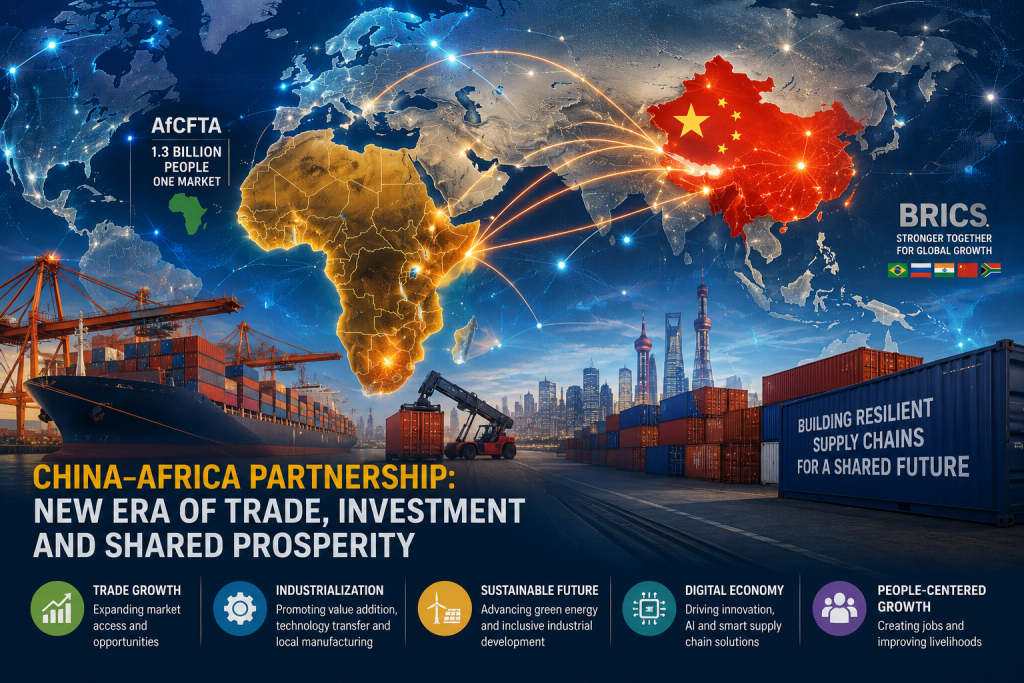
Beijing, June 22, 2026 — China is intensifying its position in global supply chains through expanded trade diplomacy and industrial cooperation, even as African economies push for stronger bargaining power under shifting global economic alliances.
The latest signals emerged at the Fourth China International Supply Chain Expo in Beijing, where officials and business leaders from across Africa joined global counterparts in discussions centered on manufacturing, logistics, digital trade, and energy transition supply chains.
The forum has become a key platform for China to reinforce its role as a central hub in global production networks, at a time when geopolitical tensions and economic fragmentation are reshaping trade routes and investment flows.
African representatives at the event, including senior government officials and private sector leaders, emphasized the need for more balanced partnerships that move beyond raw material exports toward value-added production, technology transfer, and industrial capacity building.
A central theme was the African Continental Free Trade Area (AfCFTA) African Continental Free Trade Area, which connects more than 1.3 billion people and is increasingly being positioned as Africa’s leverage tool in global negotiations.
China strengthens supply chain influence
China has in recent years expanded its presence in Africa through infrastructure financing, manufacturing investments, and digital partnerships, positioning itself as a critical node in global supply chains.
At the expo, Chinese officials framed the country’s role as essential in maintaining “resilient and interconnected” supply networks, particularly in sectors such as renewable energy, electronics, and artificial intelligence.
The event also highlighted the growing importance of BRICS cooperation frameworks BRICS, which are increasingly being viewed as alternative platforms for trade and financial coordination outside traditional Western-led systems.
Africa pushes for value addition
African delegates, however, used the platform to push for a shift in trade structure, arguing that the continent must move away from commodity dependency and toward industrialization.
Countries across Africa are seeking to negotiate more favorable terms in mineral exports, renewable energy partnerships, and digital infrastructure development, as global demand for critical raw materials continues to rise.
The push aligns with broader continental ambitions under AfCFTA, which aims to boost intra-African trade and strengthen Africa’s position in global value chains.
Global firms spotlight AI and manufacturing shifts
The expo also showcased the growing role of technology firms in shaping future supply chains, with artificial intelligence and advanced manufacturing highlighted as key drivers of competitiveness.
Global tech companies continue to expand their presence in China’s industrial ecosystem, reflecting Beijing’s strategy to integrate digital innovation with large-scale manufacturing capacity.
Strategic competition reshaping trade flows
Analysts say the current phase of global trade realignment is being driven by competition between major economic blocs, supply chain diversification strategies, and efforts by developing economies to secure better terms in global markets.
While China continues to consolidate its position as a manufacturing and logistics powerhouse, African economies are increasingly seeking to use collective frameworks such as AfCFTA to negotiate more balanced and mutually beneficial trade relationships.
The outcome, observers note, will shape the next phase of global economic architecture, particularly as emerging markets demand a greater voice in international trade governance.




More Stories
Willstone Homes Boss Ejidio Kinyanjui Faces Rape Trial
Inside Kindiki’s latest move to scuffle Gachagua’s ‘Wantam’ politics in Mt Kenya
Kenya calls for stronger after-sales support as WHX Nairobi attracts 250 healthcare firms