

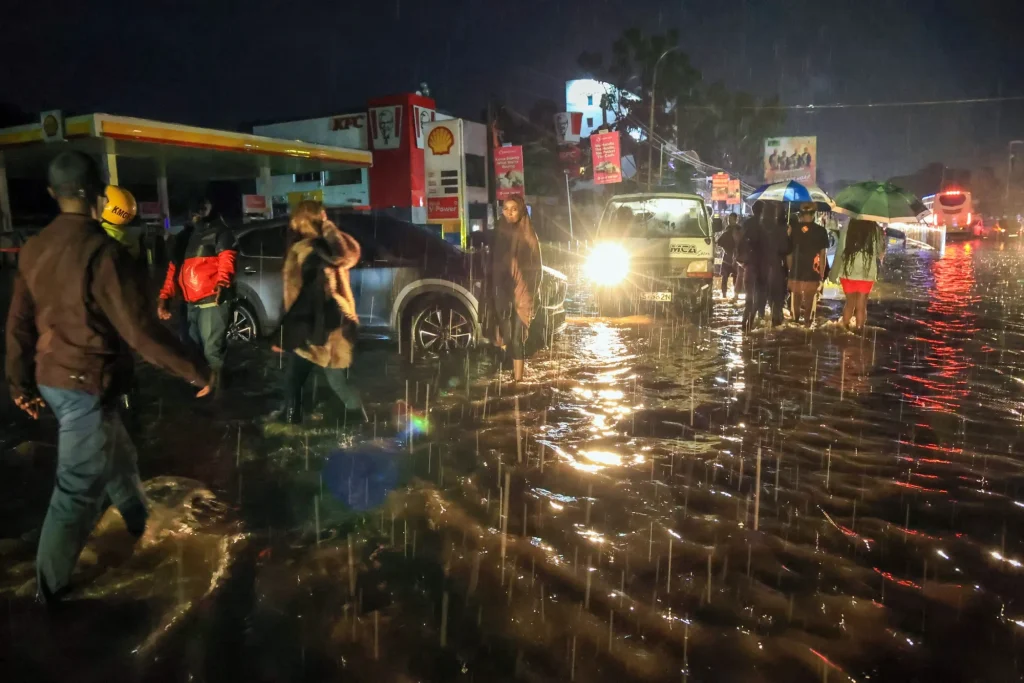
Calls are mounting for the National Government and the Nairobi City County Government to establish a special multi-agency taskforce to overhaul the city’s drainage system, following devastating floods that have repeatedly paralyzed the capital during heavy rains.
Businessman Johnson Oduk has joined urban planners, disaster experts and local leaders in calling for the taskforce which they say should be mandated to audit, rehabilitate and modernise drainage infrastructure across the city’s 85 wards within two years, warning that failure to act could worsen the growing flooding crisis.
The proposal comes as Nairobi recently experienced one of its most destructive rainstorms in years, when more than a month’s rainfall fell within just 24 hours, overwhelming drainage systems and leaving vehicles stranded on flooded roads.
At least 10 people died in the capital during the storm, with many others injured or displaced.
Oduk claims the flooding crisis in Nairobi is largely driven by outdated drainage infrastructure that can no longer cope with modern rainfall patterns and rapid urban expansion.
“Much of the city’s drainage network was constructed decades ago when Nairobi had a smaller population and less concrete development,”
Today, increased urbanization means more rainwater flows over paved surfaces into storm drains, overwhelming systems that were designed for lighter seasonal rainfall.
Urban planners also cite illegal construction on riparian land, blocked drainage channels and aging sewer systems as key factors worsening flooding in low-lying estates and major transport corridors.
In many parts of the city, burst sewer lines and flooded streets have become common during rainy seasons, highlighting the fragile state of public infrastructure.
Engineers say poor workmanship and heavy construction trucks further damage road drainage and sewer systems.
Nairobi Governor Johnson Sakaja has also blamed residents for worsening the situation through poor waste disposal practices.
According to the governor, county clean-up teams frequently remove plastic bottles, polythene bags and other garbage dumped into drainage channels, which block stormwater flow and cause flooding whenever heavy rains fall.
County officials have previously deployed workers to unclog drains across flood-prone areas such as Westlands, Kilimani and Parklands, but authorities admit that clearing waste alone cannot solve the larger infrastructure deficit.
Proposed solutions to Nairobi’s drainage crisis
Urban development experts say solving the flooding problem will require systematic reforms and strict enforcement of planning laws.
Mr. Oduk has proposed several interventions, including:Creation of a multi-agency drainage taskforce, specialized team bringing together county engineers, national road agencies, environmental experts and disaster response officials should be established to map and rehabilitate drainage systems across all 85 wards.
“The team would be given a two-year timeline to identify blocked waterways, redesign stormwater systems and expand drainage capacity,”
He also says authorities should conduct an immediate operation targeting traders and property owners occupying drainage channels, riparian reserves and stormwater corridors.
“Encroachment on these spaces has been widely blamed for obstructing water flow and increasing flood risks,”
Mr. Oduk also called for the recruitment of competent professionals to manage the disaster preparedness docket at City Hall, noting that climate change is increasing the frequency and intensity of extreme rainfall events.
Mr.Oduk has also called for community participation in clearing drains to make more practical.
“Residents and community groups should also be mobilized to participate in clearing blocked drainage channels, particularly during the rainy season,”
Experts say community engagement will help restore water flow in areas where garbage and silt accumulation frequently block storm drains.
The Nairobi City County Planning Department has been urged to tighten scrutiny during building approvals to ensure all developments include adequate drainage designs and stormwater management systems.
Urban planners warn that failure to integrate proper drainage infrastructure into new developments will continue to worsen flooding across the city.




More Stories
LG targets busy urban households with all-in-one smart laundry system
Kindiki Pledges Completion of Mau Mau Roads, Announces Sh300m Water Plan for Murang’a
Kindiki Launches Sh293 Million Irrigation Project to Benefit 1,500 Households in Murang’a