

The government has been urged to fast-track the issuance of mining licences, strengthen regulatory reforms and encourage investment in reliable mining technology to unlock Kenya’s vast mineral potential and prevent investors from shifting to neighbouring countries.
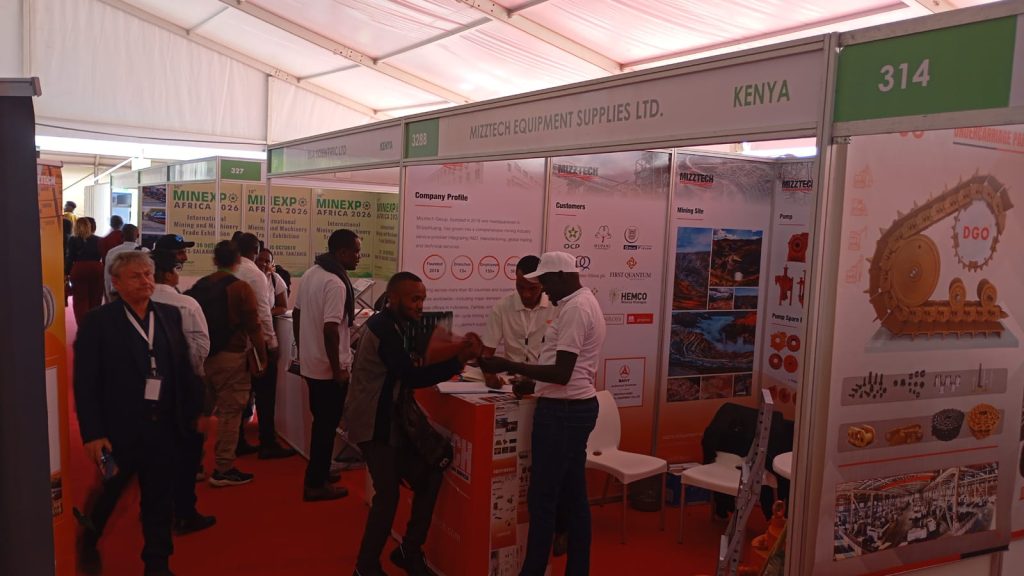
Industry players made the appeal during the 10th Minexpo Kenya, the region’s premier international mining exhibition held in Nairobi, which brought together local and international exhibitors showcasing the latest technologies in mineral extraction, earthmoving and mine safety.
Speaking at the exhibition, Mizztech Equipment Supplies Limited Kenya Country Manager Charles Komen said timely reforms and efficient licensing are critical if Kenya is to position itself as a competitive mining destination.
“We urge the government to move with speed in issuing mining licences. Many investors have waited for more than three years and are only being issued with short-term mining permits instead of licences,” Komen said.
He warned that prolonged delays could see investors redirect capital to neighbouring countries such as Tanzania and Uganda, where licensing processes are perceived to be more predictable.
“The government should ensure that everything is properly mapped on the mining cadastre and licences are issued on time. Without certainty, investors will simply choose more favourable jurisdictions,” he said.
Komen also challenged stakeholders to prioritise reforms in legislation, government engagement and community participation, saying local communities remain central to the success of mining projects.
“Communities are the gateway to these mineral resources. If they are left out of decision-making, projects will inevitably face challenges. Sustainable mining begins with engaging the people who live where the resources are found,” he said.
He added that access to dependable mining equipment is equally important in improving productivity and sustainability across the sector.
“Mining companies should invest in equipment that is reliable, experiences minimal breakdowns and delivers high-quality output with greater production capacity. Reliability reduces downtime and improves operational efficiency,” Komen said.
Mizztech Sales Engineer Brian Kiprorono said recent government reforms aimed at improving royalty sharing, local participation and community benefits have strengthened investor confidence and informed the company’s expansion plans in Kenya.
“These reforms enable us to plan for the future by investing in warehousing, increasing stock levels and hiring more employees so that we can serve customers more efficiently,” he said.
Kiprorono noted that the company is positioning itself to support Kenya’s emerging critical minerals industry by supplying durable processing equipment, engineering expertise and shorter equipment delivery times.
“As an engineering company, we are prepared to provide technical support while ensuring miners have access to robust equipment that minimises downtime and improves productivity,” he said.
The company is also investing in digital technologies that will allow mining equipment to predict failures before they occur.
“Our engineers are developing smart sensors for pumps and hydrocyclones that will detect wear and tear before equipment breaks down. This will allow miners to carry out preventive maintenance instead of reacting after failures occur,” Kiprorono said.
To support local industrialisation, Mizztech plans to establish equipment repair and assembly facilities in Kenya as mining activity expands, with long-term plans to manufacture selected products locally.
The company is also exploring equipment leasing and financing partnerships with financial institutions to help miners overcome capital constraints that often limit access to modern technology.
Beyond supplying equipment, Kiprorono said the company intends to invest in human capital by introducing graduate training programmes and scholarship opportunities for Kenyan engineering students to pursue advanced studies before returning to strengthen the local mining industry.
Meanwhile, Cyrus Njonde of Geomine Consulting Group said East Africa presents significant opportunities in critical minerals, including rare earth elements, uranium, tin and industrial minerals, as global demand for strategic minerals continues to grow.
He noted that Kenya’s deposits of gold, limestone, feldspar and gypsum, alongside emerging interest in rare earth minerals, present opportunities for increased investment and local value addition.
Komen said Mizztech specialises in manufacturing equipment across the mineral processing chain, including crushers, ball mills, flotation systems, hydrocyclones, slurry pumps, valves and ceramic-lined pipelines used in mineral processing operations.
He added that Kenya remains an attractive investment destination due to its favourable business environment, strategic location and increasing demand from small-scale and large-scale miners.
“Our message to customers and partners is simple—we are ready to grow with the industry. We are looking for partnerships that will strengthen mining across Kenya and the wider East African region,” he said.
Industry players say that with timely licensing, predictable regulations, stronger community engagement and investment in modern technology, Kenya has the potential to emerge as one of East Africa’s leading mining destinations while creating jobs, attracting foreign investment and boosting value addition within the country.




More Stories
Cledun Realtors: Land for Sale in Makutano 2026
Optiven, Promitto Partner to Help Landowners Build Homes
Co-op Bank Sponsors Fund Managers Association Golf Tournament at Karen Country Club