

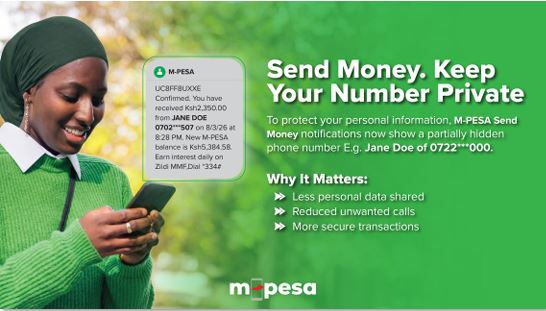
Safaricom has emphasized its responsibility in protection of data of its customers with an expected rollout of now full data minimization across its financial services (Person to person Money transfer) an approach aimed at protecting the privacy of customers across the business ecosystem.
The telecommunication giant has emphasized that the move is set to ensure that data shared in their ecosystem is handled with integrity adding that data protection is bigger than one organization, it is a nationwide conversation that needs collective action.
“From office buildings, deliveries right to our doorsteps, access of residential estates or interacting with various service providers, all these accounts to your digital footprint. Our role is to ensure that whenever customers share information in our ecosystem, only what is necessary is collected and is handled with integrity. Data protection is bigger than one organization, it is a nationwide conversation that needs collective action,” Safaricom Chief Executive Officer Peter Ndegwa stated.
This is even as the Chief Financial Services Officer Esther Waititu emphasized that the new feature is just not just being flashy but ensuring sharing less of your personal information when you do not need to.

She added that the normal reversal channels will remain the same while she pointed out that the two step Hakikisha that is currently in place has made things even easier.
“We are thinking about the balance between privacy and practicality. We are not trying to make things complicated. If anything, we are trying to take something people already do every day and make it more secure and respectful of their privacy,” she explained.
The lates move also comes in conjunction with the regulatory requirements by the Office of Data Protection as masking supports data minimization principles (used in many privacy regulations), ensuring only the minimum necessary personal data is displayed.
According to the telco, masking mobile numbers such as displaying 0722***000 instead of the full digits has become an increasingly important safeguard in digital payments platforms like M-PESA.
By limiting the visibility of personal contact information, this approach enhances customer privacy and ensures that sensitive data is not unnecessarily exposed during everyday transactions.
Beyond privacy, number masking plays a critical role in reducing unwanted communication. When full phone numbers are hidden, recipients are less able to capture and reuse them, helping curb spam calls, intrusive marketing messages, and even post-transaction harassment.
This simple layer of protection significantly improves the overall user experience in digital ecosystems.
Security is another major benefit. Fraudsters often rely on harvesting phone numbers from transaction notifications to carry out scams or social engineering attacks.
By masking these numbers, platforms reduce the amount of usable data available to bad actors, strengthening defenses against fraud.
Importantly, number masking also aligns with global data protection principles, particularly data minimization.
By displaying only the essential portion of a phone number, service providers ensure compliance with privacy standards that require limiting the exposure of personal data.
Ultimately, these measures contribute to stronger customer trust. When users feel confident that their personal information is protected, they are more likely to engage actively with digital financial services supporting broader adoption and growth of secure digital economies.




More Stories
Koimburi Accuses Gachagua of Radicalizing Mt Kenya with ‘One Term’ Campaign
Is ‘Kumi ya Ruto, Kumi ya Kindiki’ an Early Succession Campaign for 2032?
How Year of Return Africa Is Connecting Entrepreneurs to Investors, Markets and Technology