

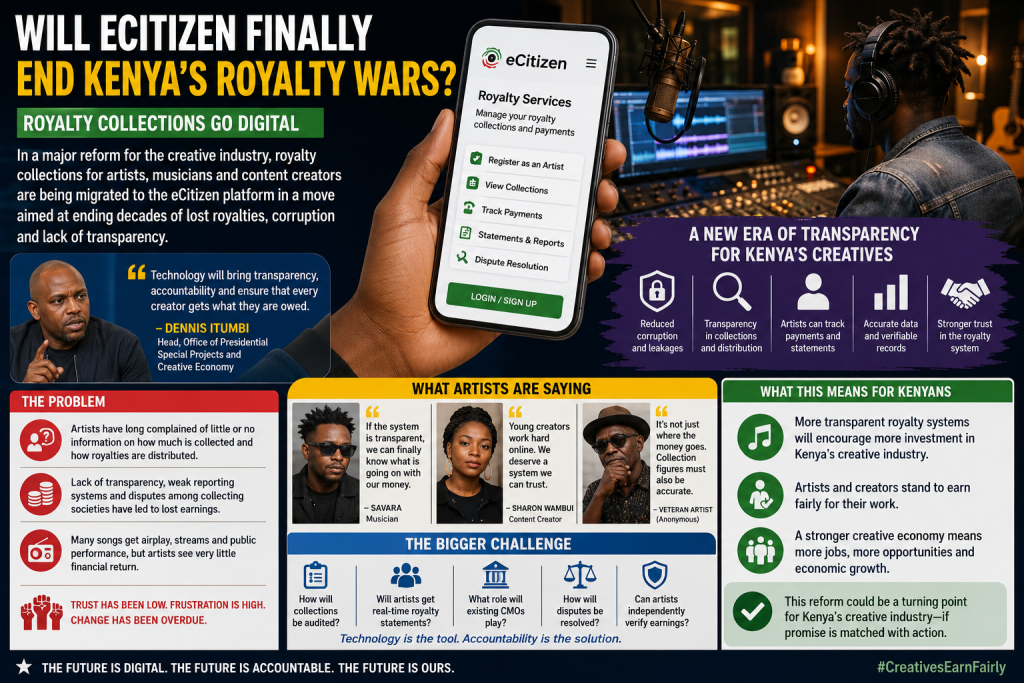
For decades, Kenya’s musicians, actors, producers and other content creators have shared a common complaint: royalties are collected in their names, but many never see the money.
Now, the government believes technology could finally provide a solution.
Under reforms being spearheaded by the Office of Presidential Special Projects and Creative Economy, led by Dennis Itumbi, royalty collection and management systems are set to be integrated into the eCitizen platform in a move aimed at increasing transparency, accountability and direct payments to artists.
The initiative is being hailed as one of the most ambitious attempts to reform Kenya’s troubled royalty ecosystem, an industry long plagued by allegations of mismanagement, opaque distribution systems and disputes between artists and Collective Management Organizations (CMOs).
But while many artists welcome the move, some remain skeptical that technology alone can solve problems that have persisted for years.
A History of Frustration
For years, artists have complained about receiving little or no information regarding how much money is collected on their behalf and how royalties are distributed.
Many musicians argue that songs continue to receive radio play, television exposure and digital streams, yet the financial returns remain negligible.
The result has been growing mistrust between creators, collecting societies and regulators.
“The biggest problem has never been collection alone. It has been transparency,” says Nairobi-based musician and producer Kevin Mwangi.
“Artists want to know how much was collected, from whom, and how the final figures were arrived at.”
How the eCitizen System Could Work
The planned migration to eCitizen seeks to create a centralized digital system where royalty-related transactions can be monitored and audited more easily.
Supporters of the initiative argue that integrating royalty collections into a government-backed digital platform could:
- Reduce leakages and corruption.
- Improve accountability in collections.
- Allow artists to track payments digitally.
- Create verifiable records of transactions.
- Increase public confidence in the royalty system.
The government believes that direct digital processing could minimize opportunities for manipulation and ensure more artists receive payments owed to them.
Artists See Opportunity — But Demand Accountability
Among younger artists and digital content creators, the proposal has generated cautious optimism.
TikTok creator and spoken-word artist Sharon Wambui says digital systems are easier for younger creatives to trust than traditional collection models.
“Most young creators already use digital platforms for business. If royalties become visible on eCitizen, people can actually track what is happening.”
However, veteran artists warn that transparency depends on more than the payment platform.
“What matters is not just where the money is deposited,” says one veteran musician. “The bigger question is whether the collection figures themselves are accurate.”
This concern reflects a broader fear within the industry: that digitizing payments may not automatically address disputes over collection methods, licensing agreements or revenue calculations.
The Bigger Challenge
Experts say the success of the reforms will ultimately depend on data accuracy and institutional accountability.
Even the most sophisticated digital system can only distribute money that has been properly collected and accurately recorded.
Questions remain over:
- How collections will be audited.
- Whether artists will have access to real-time royalty statements.
- The role of existing CMOs.
- How disputes will be resolved.
- Whether artists can independently verify earnings.
Without answers to these questions, some creators fear that the system could simply digitize existing problems.
A Turning Point for Kenya’s Creative Economy?
The reforms come at a time when the government is positioning the creative economy as a major source of jobs and economic growth.
Officials argue that a transparent royalty ecosystem could encourage more young people to pursue careers in music, film, content creation and the arts.
For many artists, however, trust will not be built through announcements alone.
The real test will come when royalty payments begin arriving consistently, transparently and in amounts creators believe reflect the true value of their work.
Until then, many artists are watching closely.
The migration to eCitizen may represent the biggest reform attempt in years, but for a creative industry that has endured decades of broken promises, proof—not promises—will determine whether this is finally the beginning of a new era.




More Stories
Willstone Homes Boss Ejidio Kinyanjui Faces Rape Trial
Inside Kindiki’s latest move to scuffle Gachagua’s ‘Wantam’ politics in Mt Kenya
Kenya calls for stronger after-sales support as WHX Nairobi attracts 250 healthcare firms