

For decades, police reforms in Kenya have been driven by a recurring public demand: a police service that is professional, accountable, responsive and trusted by citizens.
That conversation has gained fresh momentum following a meeting of the National Steering Committee on Police Reforms, which reviewed progress on five key Bills designed to reshape the country’s policing architecture.
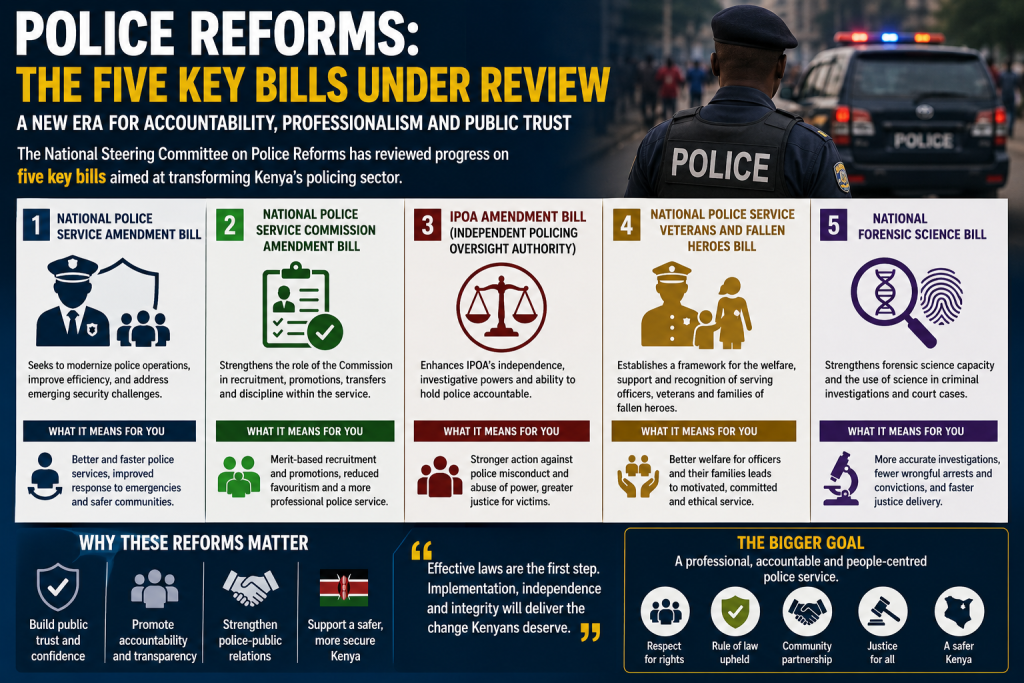
The proposed laws—the National Police Service Amendment Bill, National Police Service Commission Amendment Bill, Independent Policing Oversight Authority (IPOA) Amendment Bill, National Police Service Veterans and Fallen Heroes Bill, and National Forensic Science Bill—could significantly alter how police officers are recruited, supervised, investigated and supported.
But beyond legal language and policy discussions, what do these reforms mean for ordinary Kenyans?
1. National Police Service Amendment Bill: Improving Service Delivery
The National Police Service Amendment Bill seeks to modernize the operations of the police service and address emerging security challenges.
For citizens, the reforms could translate into more efficient policing, clearer command structures and improved service delivery. The Bill is expected to address operational gaps that have emerged since the promulgation of the 2010 Constitution and subsequent police reforms.

Supporters argue that a more efficient police service could improve response times, crime prevention and public confidence in law enforcement.
However, civil society groups are likely to closely scrutinize the Bill to ensure operational efficiency does not come at the expense of constitutional safeguards and human rights protections.
2. National Police Service Commission Amendment Bill: Who Gets Hired and Promoted?
The National Police Service Commission (NPSC) is responsible for recruitment, promotions, transfers and disciplinary oversight within the police service.
Any amendments affecting the commission could have a direct impact on professionalism within the force.
One of the long-standing public concerns has been allegations of favoritism, political interference and lack of transparency in promotions and appointments.
If strengthened, the commission could play a greater role in ensuring merit-based recruitment and career progression, ultimately producing a more professional police service.
For ordinary Kenyans, this means better-qualified officers and a system that rewards competence rather than connections.
3. IPOA Amendment Bill: Strengthening Police Accountability
Perhaps the most closely watched proposal is the amendment to the Independent Policing Oversight Authority (IPOA).
IPOA investigates allegations of police misconduct, including extrajudicial killings, torture, corruption and abuse of power.
Human rights organizations have long argued that accountability remains one of the weakest areas in Kenya’s security sector.
A stronger IPOA could enhance independent investigations into police misconduct and improve public confidence in oversight mechanisms.
For citizens who have often complained about lack of justice in cases involving police abuse, the Bill could become one of the most consequential reform measures under consideration.
The success of the reforms, however, will depend on whether IPOA receives adequate funding, independence and enforcement powers.
4. National Police Service Veterans and Fallen Heroes Bill: Recognizing Service and Sacrifice
While much attention focuses on accountability and operations, the proposed Veterans and Fallen Heroes Bill addresses the welfare of serving and retired officers.
The Bill seeks to establish a structured framework for recognizing officers injured or killed in the line of duty, as well as supporting their families.
Supporters argue that improving officer welfare contributes directly to professionalism and morale.
A police officer who feels protected by the institution is more likely to perform effectively and ethically.
The proposal also reflects a growing recognition that police reforms are not only about disciplining officers but also supporting those who serve honorably.
5. National Forensic Science Bill: Modernizing Criminal Investigations
The National Forensic Science Bill could fundamentally change how criminal investigations are conducted in Kenya.
Traditionally, many criminal cases have relied heavily on witness testimony and confessions. The new Bill seeks to strengthen the use of scientific evidence, including DNA analysis, digital forensics, fingerprint technology and crime scene investigations.
For ordinary citizens, stronger forensic capacity could lead to more accurate investigations, faster case resolution and reduced chances of wrongful arrests or convictions.
The Bill also aligns Kenya’s criminal justice system with international best practices, where science increasingly plays a central role in solving crimes.
The Bigger Question: Can the Reforms Restore Trust?
The ultimate goal of the five Bills is not simply institutional restructuring.
It is rebuilding public trust.
Years of allegations involving police brutality, corruption, enforced disappearances and excessive use of force have strained relations between citizens and law enforcement agencies.
The proposed reforms suggest that government recognizes the need for stronger accountability, improved professionalism and modern investigative capacity.
Yet legislation alone will not transform policing.
The real test will come during implementation—whether institutions are adequately funded, whether oversight bodies remain independent and whether political leaders allow reforms to operate without interference.
What Citizens Should Watch
As the Bills move through the legislative process, Kenyans should closely monitor:
- Whether public participation is adequately conducted.
- The extent of IPOA’s powers and independence.
- Changes affecting recruitment and promotions.
- Protections for human rights and constitutional freedoms.
- Funding for forensic investigations and oversight institutions.
If effectively implemented, the five Bills could mark the most significant phase of police reforms since the adoption of the 2010 Constitution.
For ordinary Kenyans, the stakes are simple: safer communities, greater accountability and a police service that enjoys the trust of the people it is meant to protect.




More Stories
Willstone Homes Boss Ejidio Kinyanjui Faces Rape Trial
Inside Kindiki’s latest move to scuffle Gachagua’s ‘Wantam’ politics in Mt Kenya
Kenya calls for stronger after-sales support as WHX Nairobi attracts 250 healthcare firms