

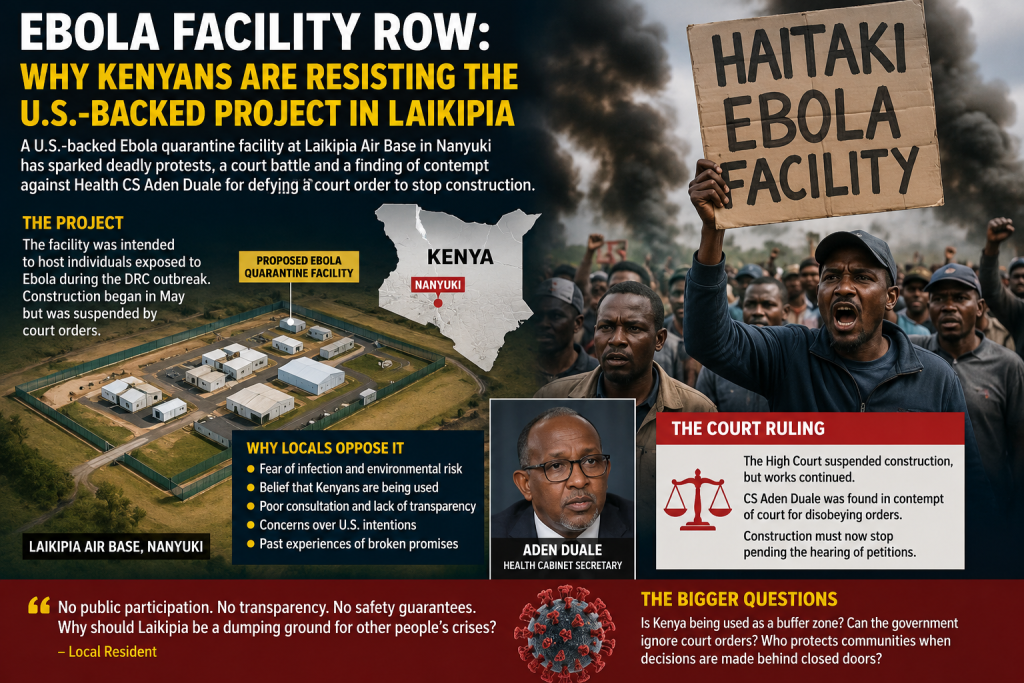
What began as a public health preparedness project has rapidly evolved into one of the most politically sensitive disputes facing the Kenya Kwanza administration.
At the center of the controversy is a U.S.-backed Ebola quarantine facility at Laikipia Air Base in Nanyuki, initially designed to accommodate American citizens exposed to Ebola during the ongoing outbreak in the Democratic Republic of Congo (DRC).
The project has triggered deadly protests, a constitutional court battle, diplomatic scrutiny, and most recently, a finding that Health Cabinet Secretary Aden Duale was in contempt of court for failing to halt construction after a judicial suspension order.
The dispute raises a larger question: Why has a health facility intended for disease preparedness generated such intense public resistance?
More Than Ebola: The Sovereignty Question
On paper, the government’s case appears straightforward.
Officials argue that the facility is a preventive measure meant to strengthen Kenya’s outbreak preparedness and support international health security cooperation. President William Ruto has defended the project as a responsible humanitarian intervention and part of Kenya’s long-standing partnership with the United States.
But among many residents of Nanyuki and beyond, the debate is not primarily about medicine.
The strongest objection has been the perception that Kenya was being asked to shoulder risks that wealthier nations were unwilling to assume themselves. Critics questioned why individuals exposed to Ebola would be quarantined in Kenya rather than in the United States, especially when Kenya itself has not reported Ebola cases. The perception that the facility was designed primarily for foreigners fueled accusations that the country was being used as a convenient buffer zone.
That narrative quickly transformed a public health project into a sovereignty issue.
Trust Deficit and Public Fear
The government has repeatedly argued that fears of an Ebola outbreak originating from the facility are scientifically unfounded. Health officials maintain that strict containment protocols would prevent any risk to surrounding communities.
Yet public health policy is not driven by science alone; it is also shaped by public trust.
For many Kenyans, memories of strained health systems during previous crises, combined with concerns about emergency preparedness, made official assurances difficult to accept. The question many residents asked was simple: if an accident occurred, would local hospitals and emergency services be equipped to respond?
The result was a widening gap between government messaging and public perception.
The Missing Public Participation Debate
Another factor driving opposition has been the issue of consultation.
Legal petitioners, including the Law Society of Kenya and Katiba Institute, have argued that the project was advanced without sufficient public participation and transparency. They contend that communities likely to be affected were not adequately informed or consulted before implementation began.
In Kenya’s constitutional framework, public participation is not merely a procedural formality. It is increasingly viewed as a prerequisite for legitimacy in major government decisions.
Whether or not the facility ultimately poses a health risk, the perception that decisions were made behind closed doors has become a political liability.
The Courtroom Challenge
The legal battle has now become almost as significant as the facility itself.
The High Court had issued conservatory orders suspending construction pending the hearing of constitutional petitions. However, construction activity allegedly continued, prompting contempt proceedings against Duale and other state officials. Justice Patricia Nyaundi Mande later found the Health CS in contempt, though she stopped short of imposing a penalty after he apologized and pledged compliance.
For constitutional lawyers, the case is no longer only about Ebola preparedness.
It has become a test of whether government agencies can proceed with politically important projects after courts have ordered them to stop.
The implications extend far beyond Laikipia. A perception that executive agencies can selectively comply with court orders would raise broader concerns about separation of powers and constitutional governance.
A Political Headache for Ruto
The controversy also presents a political challenge for President Ruto.
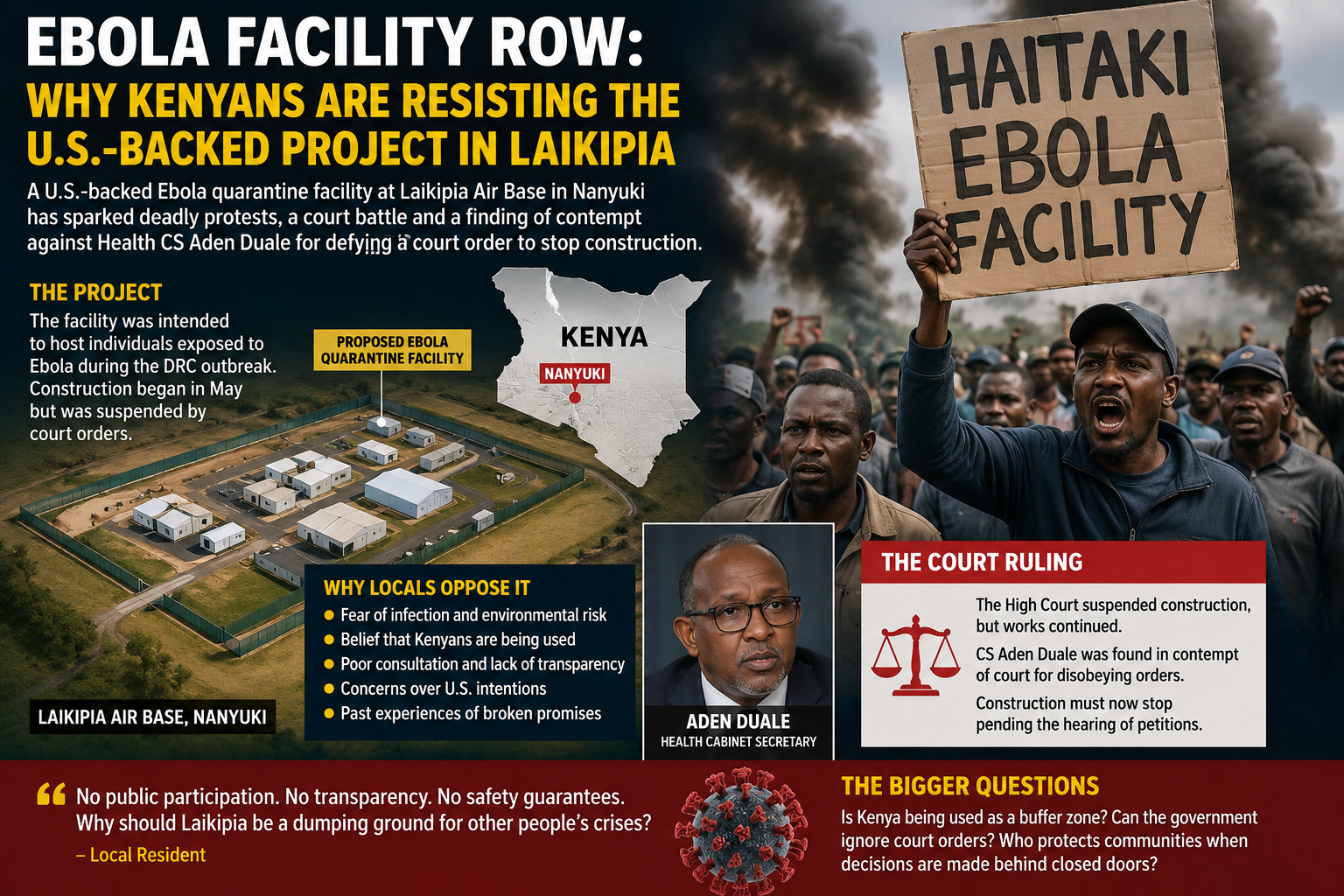
The administration has sought to portray itself as a reliable international partner capable of handling regional security and health emergencies. The Ebola facility aligned with that image. However, the intensity of domestic opposition has revealed the political costs of implementing internationally backed projects without securing local buy-in.
The deaths reported during protests elevated the issue from a policy disagreement to a national political controversy.
With the project now suspended, the government faces the difficult task of balancing diplomatic commitments, public health preparedness and constitutional accountability.
What Happens Next?
Health CS Duale has since ordered an immediate halt to construction pending the determination of the court case. The facility’s future now rests in the hands of the judiciary.
Regardless of the final ruling, the Laikipia dispute has already become a case study in the intersection of health policy, public trust, sovereignty and the rule of law.
The controversy demonstrates that in modern Kenya, even projects justified on scientific or security grounds cannot succeed without public legitimacy. And when court orders enter the equation, the issue becomes not just about policy effectiveness but about whether the state itself is willing to operate within constitutional limits.
For now, the Ebola facility stands as a symbol of a much larger debate: who gets to decide what risks Kenya takes, and under what authority those decisions are made.




More Stories
Willstone Homes Boss Ejidio Kinyanjui Faces Rape Trial
Inside Kindiki’s latest move to scuffle Gachagua’s ‘Wantam’ politics in Mt Kenya
Kenya calls for stronger after-sales support as WHX Nairobi attracts 250 healthcare firms