

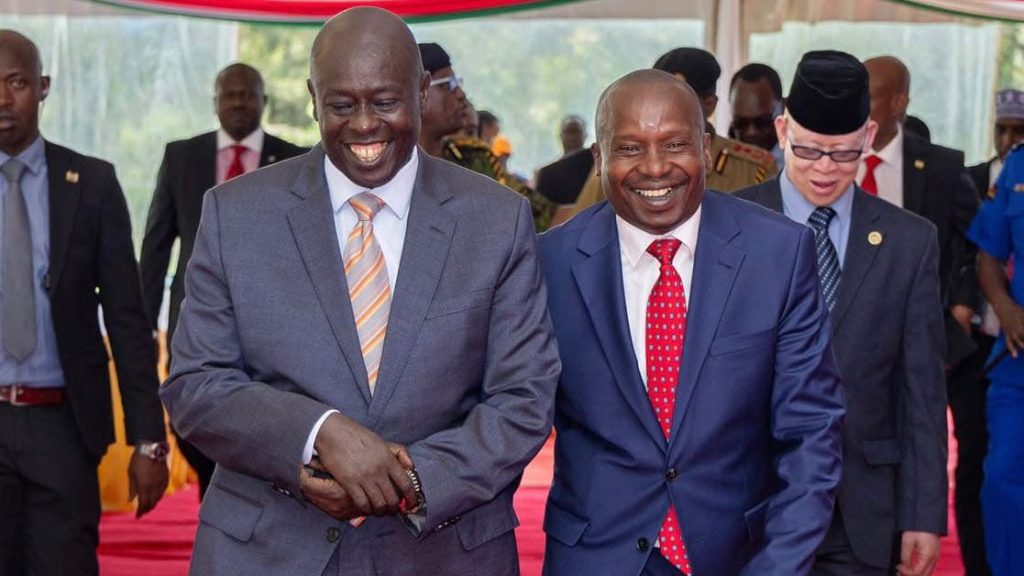
The courtroom phase of the Deputy Presidency dispute may be over, but the political battle it spawned is only beginning.
Following the High Court’s dismissal of former Deputy President Rigathi Gachagua’s challenge against the appointment of Kithure Kindiki, attention has shifted from legal arguments to an even more consequential contest: who will command the loyalty of the Mount Kenya voting bloc in 2027.
What began as a constitutional dispute has evolved into a broader struggle over political legitimacy, regional influence and succession politics within President William Ruto’s Kenya Kwanza coalition.
From Courtrooms to Campaign Trails
The latest exchange between Gachagua and Kindiki over constitutional term limits and political alignment underscores a growing rivalry that increasingly defines Mount Kenya politics.
Gachagua has positioned himself as the region’s political defender, arguing that Mount Kenya’s interests have been sidelined since his exit from government. His strategy has been to frame himself as the authentic voice of the region while portraying those who remain within government as political beneficiaries detached from grassroots concerns.
Kindiki, on the other hand, has largely anchored his political messaging around government delivery, national unity and loyalty to President Ruto’s development agenda. His allies argue that his role as Deputy President gives him access to state machinery and development projects that could help rebuild support for the ruling coalition within the region.
The result is a growing political duel between two leaders seeking to define what Mount Kenya’s future relationship with the Kenya Kwanza administration should look like.
The Fragmentation of a Once-Unified Bloc
For decades, Mount Kenya has been viewed as one of Kenya’s most cohesive voting blocs. However, the region is increasingly displaying signs of fragmentation.
The emergence of multiple political formations, shifting alliances among governors, senators and MPs, and growing debates over succession politics have weakened the notion of a single political center.
Gachagua’s influence remains significant among sections of the grassroots, particularly in areas where dissatisfaction with the national government has translated into political sympathy for his cause.
Yet Kindiki enjoys advantages that cannot be ignored. As the sitting Deputy President, he possesses institutional visibility, government backing and access to development initiatives that can be marketed as evidence of continued state commitment to the region.
The contest therefore is not merely about personalities. It is a battle between a populist regional mobilization strategy and a state-backed development narrative.
Can Kindiki Consolidate the Region?
The central question facing Kenya Kwanza is whether Kindiki can successfully consolidate Mount Kenya support before 2027.
Unlike Gachagua, whose political appeal is heavily rooted in regional identity politics, Kindiki has often projected himself as a national figure. While this approach may strengthen his standing outside Mount Kenya, some analysts argue that it could limit his ability to mobilize regional sentiment in the same way his predecessor has done.
His challenge will be convincing voters that remaining within the government’s orbit offers greater political and economic benefits than embracing a confrontational opposition posture championed by Gachagua.
Success will largely depend on whether government projects, economic recovery efforts and political outreach can reverse growing discontent in parts of the region.
Ruto’s Bigger Concern
For President Ruto, the Gachagua-Kindiki rivalry presents both a challenge and an opportunity.
A divided Mount Kenya weakens the electoral arithmetic that propelled Kenya Kwanza to power in 2022. However, if Kindiki succeeds in retaining a substantial share of the region while Ruto expands support elsewhere, the coalition could still remain competitive nationally.
The danger lies in allowing Gachagua enough political space to consolidate anti-government sentiment into a structured regional movement capable of influencing national alliances.
That possibility is already forcing political strategists to pay closer attention to Mount Kenya than at any time since the last General Election.
Looking Ahead
With the legal contest settled, the political contest has officially begun.
The battle between Gachagua and Kindiki is no longer about who occupies the Deputy President’s office. It is about who speaks for Mount Kenya, who controls its political direction and ultimately who shapes the coalition arithmetic heading into 2027.
As succession politics intensify, Mount Kenya may once again determine the outcome of a national election. The difference this time is that the region appears more divided than at any point in recent history.




More Stories
Willstone Homes Boss Ejidio Kinyanjui Faces Rape Trial
Inside Kindiki’s latest move to scuffle Gachagua’s ‘Wantam’ politics in Mt Kenya
Kenya calls for stronger after-sales support as WHX Nairobi attracts 250 healthcare firms