

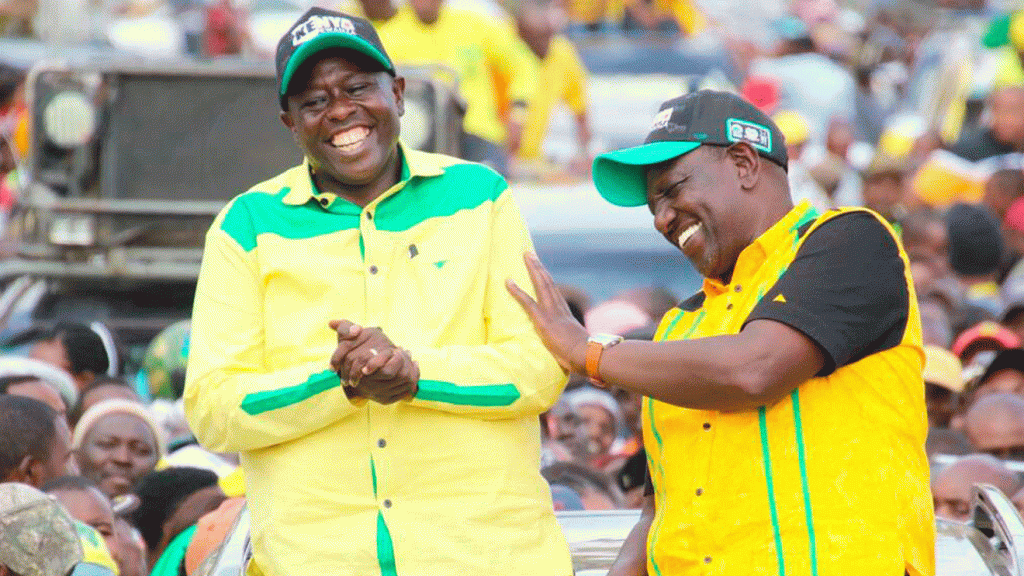
A new political narrative championed by allies of President William Ruto is increasingly shaping Kenya’s succession politics ahead of the 2027 General Election, with supporters arguing that the President’s coalition represents a break from decades of dominance by larger voting blocs.
Under the hashtag #TyrannyofSmallNumbers, Ruto’s supporters contend that Kenya’s political leadership has historically been concentrated in the hands of a few communities despite the country’s ethnic diversity.
They argue that President Ruto’s broad coalition of smaller ethnic and regional groups offers a more inclusive model of governance.
The narrative has gained traction online and in political rallies, where proponents claim that the Kikuyu community, estimated at roughly 17 percent of the population, has enjoyed disproportionate influence over state power since independence.
The debate comes as the battle for the Mt. Kenya vote intensifies following the political fallout between President William Ruto and former Deputy President Rigathi Gachagua.
Recent political messaging from Ruto’s allies has highlighted government projects in regions traditionally considered politically marginalized, particularly Northern Kenya.
Billboards and public campaigns have showcased investments in livestock value chains, roads, water projects, and other infrastructure developments as evidence of a more equitable distribution of national resources.
According to supporters of the President, the administration’s development agenda demonstrates that national leadership should not be determined solely by population size but by the ability to build broad-based coalitions across the country.
However, critics from the Mt. Kenya region have dismissed the narrative as politically motivated and potentially divisive. They argue that framing national politics through ethnic arithmetic risks deepening polarization at a time when the country should be focusing on economic recovery and national cohesion.
Political analyst Edwin Mwangi says the emergence of the “tyranny of small numbers” argument reflects a strategic attempt by Ruto’s camp to redefine electoral politics ahead of 2027.
“This is essentially an effort to build a new political majority by bringing together communities that have historically felt excluded from the centre of power. It is a coalition-building strategy designed to counter the numerical strength of larger voting blocs,” he said.
Another political analyst, Kakure Ndomi , notes that the narrative is likely to become a central feature of the next election cycle as political camps compete to frame the national conversation.
“What we are witnessing is a contest between two political philosophies. One side is emphasizing regional voting strength, while the other is promoting coalition politics built around multiple smaller communities. The side that successfully sells its narrative to voters may gain a significant advantage heading into 2027,” he observed.
Despite the growing popularity of the slogan among government supporters, analysts caution that ethnic-based political messaging remains sensitive in Kenya and should be handled carefully.
Governance expert Javas Bigambo argues that while discussions about representation are legitimate, leaders must avoid rhetoric that could inflame ethnic tensions.
“Kenya’s future depends on issue-based politics. Development, jobs, healthcare, education and the cost of living should remain at the centre of public debate rather than narratives that risk reopening historical ethnic divisions,” he said.
The debate unfolds against a backdrop of mixed political fortunes for the President. While a May 2026 TIFA survey showed strong support for Ruto in parts of Northern Kenya, national approval ratings remain under pressure amid persistent concerns over the economy, taxation and the rising cost of living.
With less than two years before the next General Election, the battle for political narratives is increasingly becoming as important as the battle for votes, setting the stage for what is expected to be a highly competitive and ideologically charged 2027 campaign.



More Stories
Why Russian Officials Want To Join Anticolonial Rhetoric
Trust Summit 2026 Adopts 29-Point Nairobi Call to Action
Safaricom Introduces Biometric Verification in Franchise Shops to Improve Customer Service