

By Vyshelle Andola
Kenya is set to overhaul its bank licensing fee structure for the first time in more than three decades, marking a major shift in how financial institutions are regulated.

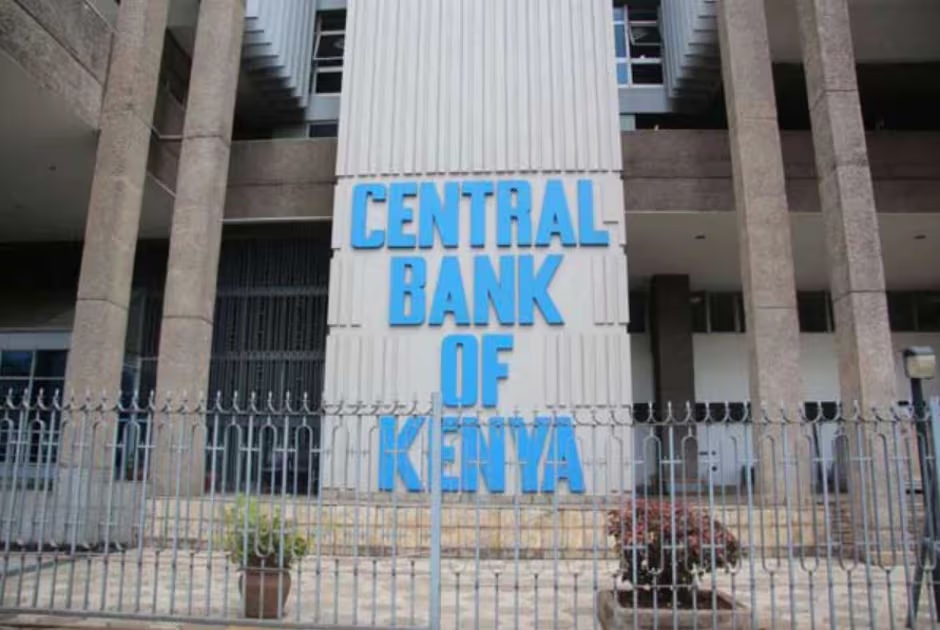
The Central Bank of Kenya (CBK) has proposed replacing the current branch-based licensing fee system with a revenue-based model, aligning Kenya with modern banking practices adopted across the region.
CBK Governor Dr. Kamau Thugge said the review was necessary because Kenya’s licensing fees have remained the lowest in East Africa compared to Uganda, Rwanda and Tanzania.
“This review is justified by the fact that the licence fees are the lowest in East Africa compared to Uganda, Rwanda and Tanzania. It is also due to the increasing size and complexity of the banking sector,” he said.
The current fee structure has remained unchanged since 1990. Under the existing system, banks pay a flat fee of Sh400,000 for a head office, while branch fees vary by location: Sh150,000 in municipalities, Sh100,000 in town councils and Sh30,000 in urban centres. Non-operating holding companies pay Sh500,000, while third-party agents are charged Sh1,000 annually.
Despite the banking industry’s rapid growth—from total assets of Sh202 billion in 1994 to Sh7.6 trillion in 2024—the licensing fees have not been revised.
Under the proposed Banking (Fees) Regulations, 2025, banks will instead pay a percentage of their gross annual revenue (GAR) under a phased implementation schedule:
- 2026: 0.13% of gross annual revenue
- 2027: 0.14% of gross annual revenue
- 2028 and beyond: 0.15% of gross annual revenue
The revised rates are significantly lower than CBK’s initial proposal of between 0.6% and 1% following consultations with stakeholders.
Gross annual revenue will include income from interest on loans, government securities, fees, commissions, dividends and foreign exchange trading. The licensing fees will be calculated using the previous year’s audited financial statements and must be paid within 15 days after the accounts are published.
According to the CBK, the new framework is designed to align Kenya with international regulatory standards, ensure banks contribute according to their size and risk profile rather than the number of branches they operate, and provide the regulator with adequate resources to strengthen supervision of the banking sector.
The central bank estimates the revised model will generate about Sh4.5 billion in the first year, rising to Sh7.5 billion by the third year, although the lower rates could reduce the projected collections.
However, the Kenya Bankers Association (KBA) has opposed the proposal, arguing that charging fees based on gross annual revenue unfairly affects banks with high revenues but relatively low profit margins.
The association has instead proposed using profit after tax as the basis for calculating licence fees. Based on the banking industry’s 2024 net profits of Sh207.8 billion, this approach would generate approximately Sh1.2 billion, far below the CBK’s projected collections.
KBA Chief Executive Officer Raimond Molenje warned that the proposed fees could increase banks’ operating costs, which may ultimately be passed on to customers through higher lending rates.
The association also noted that Kenya’s proposed rates remain relatively high compared to regional peers, even after the reductions. Uganda charges banks 0.05% of gross annual revenue, while Rwanda levies 0.5%, raising concerns about Kenya’s competitiveness within the East African banking sector.



More Stories
Kenya Power Barred From Disconnecting Electricity to Essential Facilities
Former TUM Student Leader Elvis ‘The BEAST’ Otieno Dies
Government Begins Buying First Rice Harvest from Revived Kimira-Oluch Irrigation Scheme